Korean Traditional Music: Gugak, Pansori and Gayageum
Long before K-pop, Korea developed a rich traditional music called gugak. The epic storytelling of pansori, the gayageum zither, royal ritual music, samul nori drumming, sanjo and the song Arirang.
In this guide
Korea is famous around the world for K-pop, but behind it lies a rich traditional music known as gugak, meaning “national music”. It includes the solemn ritual music of the royal court, the powerful storytelling of pansori, the delicate sound of the gayageum zither and the thunderous drumming of samul nori. Many of these traditions are recognised by UNESCO and are performed today in concert halls, festivals and villages, while younger musicians blend them with pop and electronic music. This guide introduces the main forms of Korean traditional music.
Court music and folk music
Korean traditional music is often divided into two broad categories. Jeongak includes court music, ritual music and the music of the aristocracy, generally slow, dignified and refined. Minsogak includes folk music, such as folk songs, farmers’ music, shamanic music, pansori and sanjo, which tends to be more expressive and energetic. Both remain important parts of Korea’s musical heritage.
Jongmyo ritual music
At the Jongmyo Shrine in Seoul, the royal ancestral shrine of the Joseon dynasty, an elaborate ritual honouring the kings and queens of the dynasty is performed each year, accompanied by music and dance. This ritual music, known as Jongmyo jeryeak, features bells, stone chimes, drums, wind instruments and singers, and has been performed for centuries. In 2001, the Jongmyo ritual and its music were among the first items recognised by UNESCO as Masterpieces of the Oral and Intangible Heritage of Humanity.
Pansori: epic storytelling in song
Pansori is a form of musical storytelling performed by a single singer, called a sorikkun, accompanied by a drummer, called a gosu, playing a barrel drum called the buk. The singer alternates between singing, speech and gesture, holding a fan, and may perform a single story for several hours. The drummer keeps the rhythm and calls out encouraging exclamations, called chuimsae, and the audience may join in. Pansori singers train for many years to develop a powerful, husky voice capable of expressing great emotion.
| Pansori story | Theme |
|---|---|
| Chunhyangga | Love and faithfulness |
| Simcheongga | A daughter’s devotion to her blind father |
| Heungbuga | Two brothers, one kind and one greedy |
| Sugungga | A rabbit, a turtle and the Dragon King |
| Jeokbyeokga | A battle from Chinese history |
These five stories are the surviving classical pansori repertoire. Pansori was recognised by UNESCO in 2003.
The gayageum
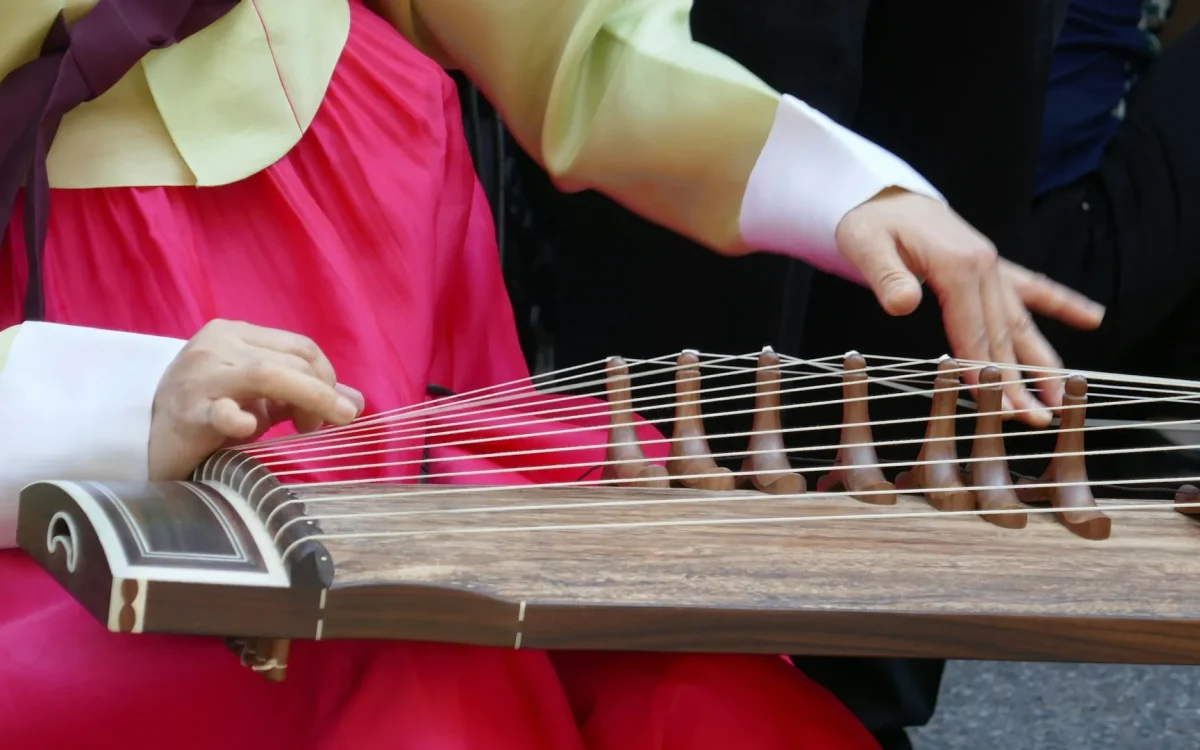
The gayageum is a zither, traditionally with twelve silk strings stretched over movable bridges. According to tradition, it was created in the sixth century in the Gaya confederacy, in the south of the Korean peninsula. The player plucks the strings with the fingers of the right hand and presses them with the left hand to create vibrato and bends. Its sound is warm and expressive. Modern versions with more strings are used for contemporary music. The gayageum is related to the Chinese guzheng and Japanese koto. See Chinese traditional instruments.
Other instruments
The geomungo is a six-stringed zither played with a short bamboo stick, producing a deep, strong sound associated with scholars. The haegeum is a two-stringed fiddle, related to the Chinese erhu. The daegeum is a large bamboo flute with a membrane that adds a buzzing tone. The piri is a small double-reed instrument with a strong sound, and the janggu, an hourglass-shaped drum played with a stick and the hand, is used in many genres.
Sanjo
Sanjo is a form of solo instrumental music, played on the gayageum, geomungo, daegeum and other instruments, accompanied by the janggu. A sanjo piece begins slowly and gradually accelerates through a series of rhythmic cycles, called jangdan, ending at a fast tempo. Sanjo combines composed and improvised elements and allows players to show their expressive and technical skill.
Samul nori and pungmul
Pungmul, also called nongak, is a tradition of farmers’ music, with drums, gongs, wind instruments and dancing, performed at village festivals and agricultural rituals. In 1978, a group of musicians led by Kim Duk-soo created samul nori, a stage version using four percussion instruments: the kkwaenggwari (small gong), jing (large gong), janggu and buk. Samul nori became hugely popular in Korea and abroad. The four instruments are often associated with natural elements: thunder, wind, rain and clouds.
Arirang
Arirang is Korea’s best-known folk song, with many regional versions sung across North and South Korea and by Korean communities abroad. Its simple refrain and themes of longing and parting make it a symbol of Korean identity. UNESCO recognised Arirang in 2012 (South Korea) and 2014 (North Korea).
Han and emotion
Korean traditional music is often associated with han, a complex feeling that combines sorrow, longing, resentment and resilience. Pansori and folk songs, in particular, express han through their vocal intensity and expressive ornamentation. At the same time, much Korean traditional music is joyful and celebratory, especially pungmul and festival music.
A closer look: gugak meets pop
In recent years, Korean musicians have blended traditional music with pop, rock and electronic music. The band Leenalchi, which combines pansori singing with bass and drums, became widely known in 2020 through a series of tourism videos. Some K-pop artists also incorporate traditional instruments and melodies. These projects show that gugak remains a living, evolving tradition.
Putting it into practice
Listen to an excerpt from a pansori performance, a gayageum sanjo and a samul nori performance, and compare them. The Music Culture Storyteller AI can tell you the stories behind pansori, and the Global Playlist Curator AI can suggest recordings.
Frequently asked questions
What is gugak?
Korean traditional music, including court, ritual and folk forms.
What is pansori?
A form of epic musical storytelling by a singer and a drummer.
What are the four instruments of samul nori?
The kkwaenggwari and jing gongs and the janggu and buk drums.

Questions and notes