Learning the Kalimba: First Steps and First Tunes
The kalimba is one of the easiest instruments to start: pick it up, play with your thumbs and a melody appears. How the keys are laid out, reading tabs, tuning, first tunes, chords and how it relates to the African mbira.
In this guide
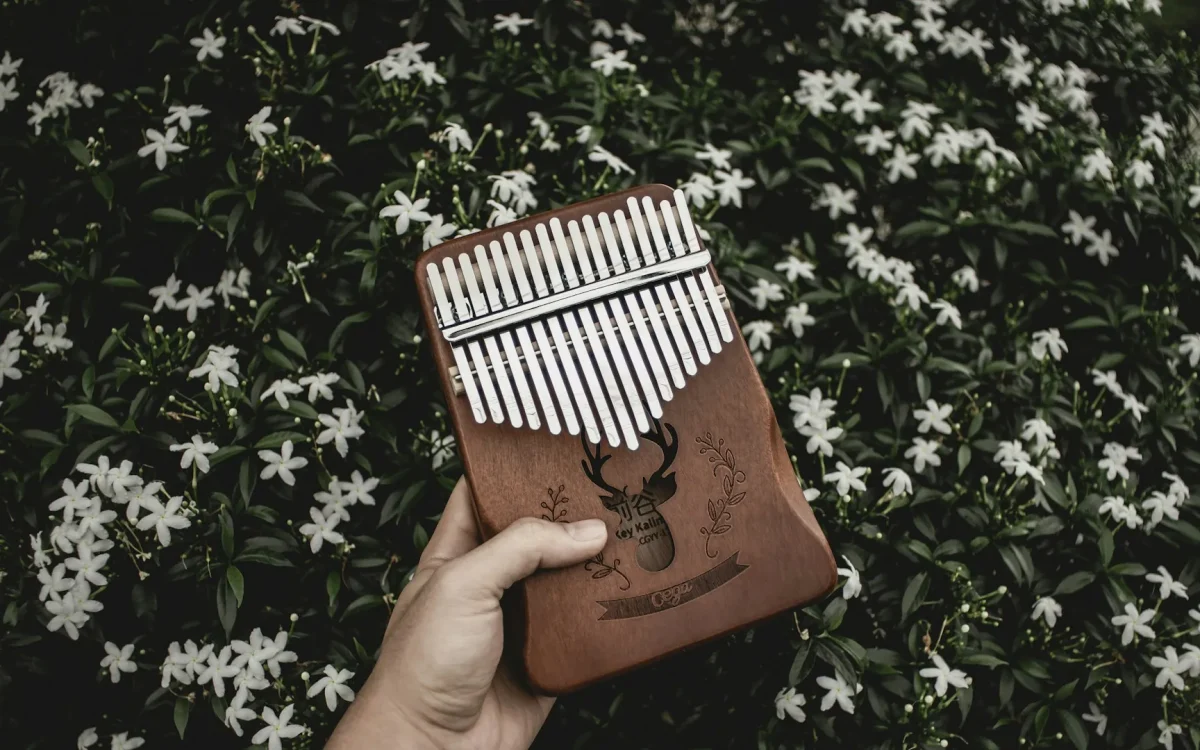
The kalimba is one of the most inviting instruments for beginners. Its sweet, bell-like notes sound beautiful from the first moment, it fits in a bag, and you can learn simple melodies in an afternoon. Played with the thumbs, the kalimba has become hugely popular around the world, with countless tutorials and songbooks available. This guide explains how the kalimba works, how to read kalimba tabs and how to play your first tunes and chords.
From mbira to kalimba
The kalimba belongs to the lamellophone family, instruments with metal or bamboo keys fixed to a soundboard, which have been played across Africa for centuries. The Zimbabwean mbira is one of the best-known traditional examples. In the mid-twentieth century, the British ethnomusicologist Hugh Tracey, who lived in southern Africa, developed and commercially produced a simplified instrument tuned to a Western scale, which he called the kalimba. Today, the name is used for many modern instruments made around the world. See the mbira.
Choosing a kalimba
| Feature | Recommendation for beginners |
|---|---|
| Number of keys | 17 keys, the most common, with many tabs available |
| Tuning | C major, the standard tuning for songbooks |
| Body | Flat board for clarity; hollow body for volume and vibrato |
| Accessories | Tuning hammer, note stickers, case |
| Keys | Smooth, well-finished tines that do not hurt the thumbs |
A 17-key kalimba in C covers just over two octaves and can play thousands of melodies. See our guide to the best kalimbas.
How the keys are arranged
Unlike a piano, the kalimba’s keys are not arranged from low to high from left to right. The lowest note is the longest key in the centre, and the notes go up alternately to the left and right: the next note is to the left of centre, the next to the right, and so on. This means that neighbouring keys on opposite sides of the centre are a third apart, which makes it easy to play pleasant harmonies. It takes a little time to get used to, but the layout soon feels natural.
Reading kalimba tabs
Most kalimba music is written in tabs that use numbers for the notes of the scale: 1 for C (do), 2 for D (re), 3 for E (mi), up to 7 for B (ti). A dot above a number means the note is an octave higher, and two dots mean two octaves higher. Many kalimbas come with these numbers engraved on the keys, making it easy to follow tabs. Some tabs show the key layout visually instead.
Tuning your kalimba
A kalimba is tuned by sliding the keys in or out with a small tuning hammer: tapping a key towards you (making it longer) lowers its pitch, and tapping it away (shorter) raises it. Use a tuner app to check each note. New kalimbas often need small adjustments, and it is worth checking the tuning regularly. Make small taps rather than large movements.
Thumb technique
Hold the kalimba with both hands, fingers supporting the back, and pluck the keys with the tips of your thumbs, using a downward flicking motion. The thumbnail can produce a brighter sound; the pad of the thumb a softer one. Strike near the end of the key for the clearest tone. Keep your hands relaxed. Some beginners find their thumbs sore at first; this passes with practice.
Your first tunes
Start with simple melodies such as “Twinkle Twinkle Little Star”: 1 1 5 5 6 6 5, 4 4 3 3 2 2 1. Then try “Ode to Joy”: 3 3 4 5 5 4 3 2 1 1 2 3 3 2 2. These traditional or public domain tunes are ideal for learning the key layout. You can practise them on our online kalimba player before trying them on a real instrument.
Playing chords
Because neighbouring keys across the centre are a third apart, you can play two-note harmonies by plucking two adjacent keys together with one thumb, sliding across them. Three adjacent keys produce a full chord: for example, 1, 3 and 5 for a C major chord. Try playing a melody with one thumb while the other plays chords or a simple bass note, which creates a fuller, richer sound.
Vibrato and effects
On a hollow-body kalimba, you can create a “wah” or vibrato effect by covering and uncovering the sound holes on the back with your fingers while a note rings. You can also tap the body for percussive sounds. These effects add expression and are part of what makes the kalimba so charming.
A practice plan
Practise for ten to fifteen minutes a day. Spend a few minutes playing scales up and down to learn the layout, then work on a tune. Each week, learn a new melody and add simple chords. After a month, you will be able to play many familiar tunes and begin creating your own melodies.
A closer look: playing by ear
Once you know the layout, try picking out melodies you know by ear, without tabs. Start on the note 1 and search for the next note by trying neighbouring keys. This develops your ear and helps you understand how melodies are built. The kalimba’s simple scale makes it ideal for playing by ear, since there are no wrong notes outside the scale.
Putting it into practice
Learn “Twinkle Twinkle” and “Ode to Joy” this week, then add chords. The Learn a World Instrument Coach AI can create a personalised plan, and our tongue drum vs handpan guide explores other melodic percussion instruments.
Frequently asked questions
Is the kalimba easy to learn?
Yes. Its keys are tuned to a scale, so simple melodies sound good almost immediately.
How many keys should a beginner’s kalimba have?
A 17-key kalimba in C is the most common and has the most tabs available.
How do I tune a kalimba?
Tap the keys with a tuning hammer: longer keys sound lower, shorter keys higher.



Questions and notes