Frame Drums of the World: Bodhrán, Tar and Bendir
Frame drums are among the oldest drums on earth: a skin stretched over a wide, shallow hoop. A tour of the bodhrán, tar, bendir, daf, pandeiro, tamburello and kanjira, how each is held and played, and how to choose your first frame drum.
In this guide
A frame drum is one of the simplest instruments imaginable: a skin stretched over a wide, shallow wooden hoop. Yet frame drums are found on almost every continent, in the hands of Irish session players, Moroccan Sufi musicians, Brazilian samba percussionists, Italian folk dancers and South Indian classical drummers. They can produce deep, resonant basses, crisp high tones and shimmering jingles. This guide takes you on a tour of the world’s frame drums and explains how to start playing.
An ancient drum
Frame drums are among the oldest drums known. Images of frame drums appear in art from ancient Mesopotamia, Egypt and the eastern Mediterranean, often played by women in religious ceremonies. Over thousands of years, the frame drum spread through the Middle East, North Africa, Europe and Asia, taking many local forms. In many traditions, it remains associated with ritual, healing and celebration.
A family of drums
| Drum | Region | Feature |
|---|---|---|
| Bodhrán | Ireland | Played with a stick; hand inside changes pitch |
| Tar | North Africa, Middle East | Plain frame without jingles |
| Bendir | North Africa | Snares beneath the skin create a buzz |
| Daf | Iran, Kurdistan | Large, with metal rings inside the frame |
| Pandeiro | Brazil | Tambourine with jingles, used in samba and capoeira |
| Tamburello and tammorra | Italy | Jingled drums for tarantella and tammurriata |
| Kanjira | South India | Small drum with one pair of jingles |
The bodhrán
The bodhrán is the Irish frame drum, usually covered with goatskin and played with a small wooden stick called a tipper or cipín. The player holds the drum upright against the body and places the other hand inside the frame, pressing on the back of the skin to change the pitch and tone. Although frame drums have long existed in Ireland, the bodhrán became a standard instrument in Irish traditional music from the 1960s. Good bodhrán players use subtle techniques, producing a wide range of tones. See Irish traditional music.
Tar and bendir
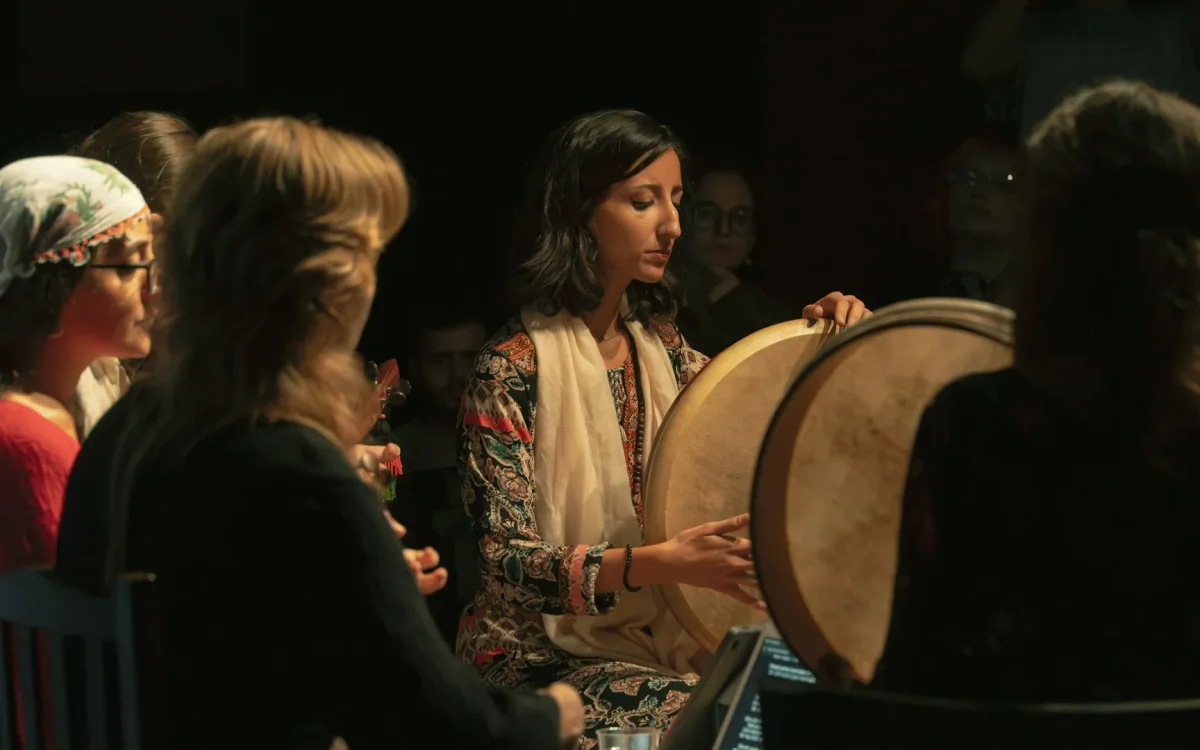
The tar is a frame drum without jingles, played with the fingers in North Africa and the Middle East. It produces a clear bass in the centre and crisp tones near the rim. The bendir, common in Morocco, Algeria and Tunisia, has one or more snares, gut strings stretched beneath the skin, that produce a buzzing sound. Both are used in Sufi ceremonies, folk music and celebrations. Players hold the drum vertically, with the thumb through a hole in the frame, and strike with the fingers of both hands.
The daf
The daf is a large frame drum from Iran and Kurdistan, with metal rings attached to the inside of the frame. When the drum is struck or shaken, the rings jingle, creating a rich, shimmering sound. The daf is closely associated with Sufi music, where its powerful rhythms accompany devotional singing and gatherings, and it has become popular in Persian classical and popular music. See Persian classical music.
The pandeiro
The pandeiro is a Brazilian tambourine with a head and jingles. It is played in samba, choro and capoeira, and skilled players can produce an astonishing range of sounds, from deep basses to slaps and jingle rolls, making the pandeiro sound almost like a whole percussion section. Players hold it in one hand and strike it with the thumb, fingers, palm and heel of the other hand, sometimes rotating it. See samba.
Italy, Portugal and beyond
In southern Italy, the tamburello drives the pizzica and tarantella, played with energetic rolling techniques, and the larger tammorra accompanies the tammurriata dances of Campania. In Portugal, the adufe, a square frame drum with seeds or pebbles inside, is traditionally played by women in the Beira Baixa region. Many other regions have frame drums, from the Russian buben to the shamanic drums of Siberia and the Sámi, and the hand drums of many Native American peoples. See Italian folk music.
The kanjira
The kanjira is a small frame drum used in South Indian Carnatic music, with a single pair of metal jingles. It was traditionally covered with lizard skin, though other materials are now used. The player holds it in one hand and plays with the fingers of the other, using pressure from the holding hand to bend the pitch. In Carnatic concerts, the kanjira often accompanies the mridangam and takes part in percussion solos. See Carnatic music.
Basic technique
Most hand-played frame drums share basic sounds: a bass, produced by striking the centre with the fingers or palm and letting it ring; a high tone, produced by striking near the rim with one or two fingers; and a slap, produced with a sharp, muted stroke. Hold the drum vertically or at an angle, with the frame resting on your leg or supported by one hand, and keep your hands relaxed. Many traditions also use finger rolls and snaps.
Choosing your first frame drum
For a first drum, consider which music interests you. For Irish music, choose a bodhrán with a tipper; for Middle Eastern and North African music, a tar or bendir; for Brazilian music, a pandeiro. A medium-sized drum, around 35 to 45 cm, is easy to handle. Natural skins sound warmer but react to humidity; synthetic heads are more stable. See our guide to the best frame drums and bodhráns.
A closer look: the hand inside
On many frame drums, the hand holding the drum can change the sound. On the bodhrán, pressing the inside of the skin raises the pitch and shortens the sustain. On the kanjira, pressure from the holding hand bends the pitch upward. Experiment by striking the drum while moving your holding hand, and listen to how the sound changes.
Putting it into practice
Listen to a bodhrán in an Irish session, a daf in Persian Sufi music and a pandeiro in samba, then choose a drum to start with. Practise bass and tone strokes for ten minutes a day with our metronome. The World Rhythm Coach AI can teach you rhythms for each drum.
Frequently asked questions
What is a frame drum?
A drum with a skin stretched over a wide, shallow frame, played with the hands or a stick.
How is the bodhrán played?
With a small stick called a tipper, while the other hand inside the frame changes the pitch.
What is the difference between a tar and a bendir?
A bendir has snares under the skin that buzz; a tar does not.
Questions and notes