Indian Classical Music: Understanding Raga and Tala
Raga and tala are the two pillars of Indian classical music. What a raga is, why ragas belong to times of day, how rhythmic cycles like teentaal work and how a concert unfolds from slow alap to fast climax.
In this guide
An Indian classical concert can seem mysterious at first. A performance may begin with long, slow, unaccompanied phrases, build gradually for an hour or more and end in dazzling speed, with musicians exchanging smiles as they meet on the first beat of a rhythmic cycle. Behind this music lie two ideas that have guided Indian musicians for centuries: raga, the melodic framework, and tala, the rhythmic cycle. Once you understand these, Indian classical music opens up as one of the world’s richest musical traditions. This guide explains the essentials in plain language.
Two great traditions
Indian classical music has two main branches. Hindustani music developed in northern India, Pakistan, Bangladesh and Nepal, and was shaped by contact with Persian and Central Asian culture in royal courts. Carnatic music developed in southern India and is closely linked with devotional song. Both share the concepts of raga and tala but differ in style, repertoire, instruments and performance practice. This guide focuses mainly on the Hindustani tradition; see Carnatic music for the southern tradition.
What is a raga?
A raga is much more than a scale. It is a melodic framework that defines which notes may be used, how the melody ascends and descends, which notes are emphasised, which characteristic phrases identify it and what mood it expresses. Two ragas may use exactly the same notes and still be completely different because of their typical phrases and emphasis. Musicians spend years learning a raga’s personality, much as one gets to know a person, and they improvise within its rules to express its mood.
Sargam: the Indian note names
Indian musicians name the notes of the scale with the syllables Sa, Re, Ga, Ma, Pa, Dha and Ni, similar to the Western do-re-mi system. Sa is the tonic, the home note, and it is not fixed to a particular pitch: each performer chooses the pitch of Sa that suits their voice or instrument. Some notes can be natural, flattened or sharpened, giving many possible combinations. Singers often sing sargam syllables during improvisation, which helps listeners follow the melody.
| Element | Meaning |
|---|---|
| Aroha | The ascending pattern of a raga |
| Avaroha | The descending pattern |
| Vadi | The most important note |
| Samvadi | The second most important note |
| Pakad | A characteristic phrase that identifies the raga |
| Rasa | The emotional flavour the raga evokes |
Ragas and the time of day
In Hindustani music, many ragas are traditionally associated with particular times of day or seasons. Raga Bhairav, for example, is a dawn raga, serious and devotional; Raga Yaman is performed in the early evening, with a calm, luminous quality; Raga Malkauns belongs to late night, with a deep, meditative mood. Some ragas are linked with the monsoon. Musicians do not always follow these associations strictly today, especially in recordings, but they remain an important part of how ragas are understood.
The drone
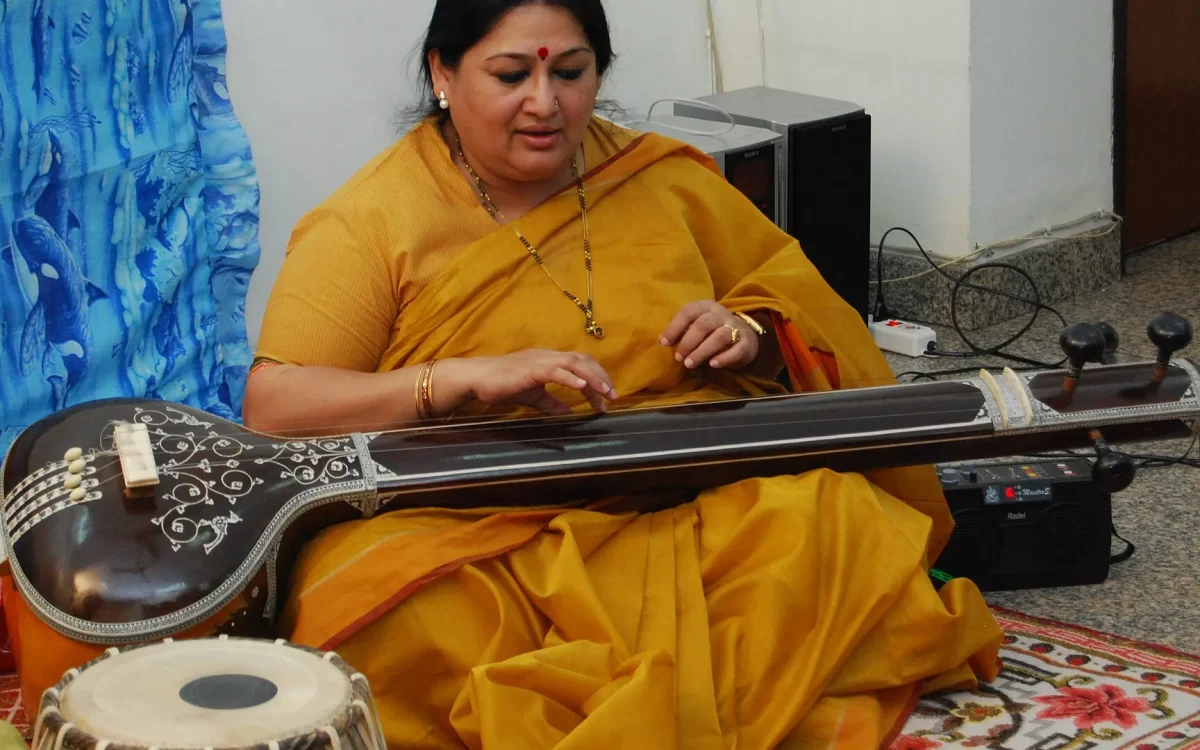
Indian classical music is performed over a continuous drone, usually provided by the tanpura, a long-necked plucked instrument whose open strings are played in a repeating cycle. The drone sounds the tonic and usually the fifth, creating a constant reference point. Every note of the melody is heard in relation to this drone, which is why Indian musicians are so sensitive to precise intonation and subtle shades of pitch. Today, electronic drone boxes and apps are also used.
What is tala?
Tala is the rhythmic framework of Indian classical music: a cycle of a fixed number of beats that repeats throughout a piece. Each tala is divided into sections, with certain beats emphasised by claps and others marked by a wave of the hand. The first beat, called sam, is the most important: improvisations often build towards it, and musicians and listeners feel a release when everyone lands on sam together.
| Tala | Beats | Divisions |
|---|---|---|
| Teentaal | 16 | 4 + 4 + 4 + 4 |
| Jhaptaal | 10 | 2 + 3 + 2 + 3 |
| Rupak | 7 | 3 + 2 + 2 |
| Ektaal | 12 | 2 + 2 + 2 + 2 + 2 + 2 |
| Dadra | 6 | 3 + 3 |
The section called khali (“empty”) is marked by a wave rather than a clap, and the tabla plays it with a lighter sound, helping listeners keep track of where they are in the cycle.
How a performance unfolds
A typical instrumental performance of a raga begins with the alap, a slow, unmetered exploration of the raga’s notes and phrases, without percussion. It continues with the jor, which introduces a steady pulse, and the jhala, a fast, rhythmic section. Then the composition, called a gat on instruments or a bandish in vocal music, begins with tabla accompaniment, and the musicians improvise around it, gradually increasing the tempo until a thrilling climax.
Gharanas and the guru
Indian classical music has traditionally been passed down from teacher (guru) to student (shishya) over many years, in a relationship that combines musical training with personal devotion. Different lineages, called gharanas, developed distinctive styles of singing or playing. Students learn by listening, imitating and practising for many hours, and the knowledge carried by each gharana is treasured.
A closer look: following the cycle
To follow a tala, try counting along with a teentaal performance. Clap on beats 1, 5 and 13 and wave on beat 9, counting all sixteen beats in between. At first it will be difficult, especially when the soloist improvises across the cycle, but you will soon feel the excitement as the soloist and tabla player return to sam together. Use our metronome to practise slow cycles.
Putting it into practice
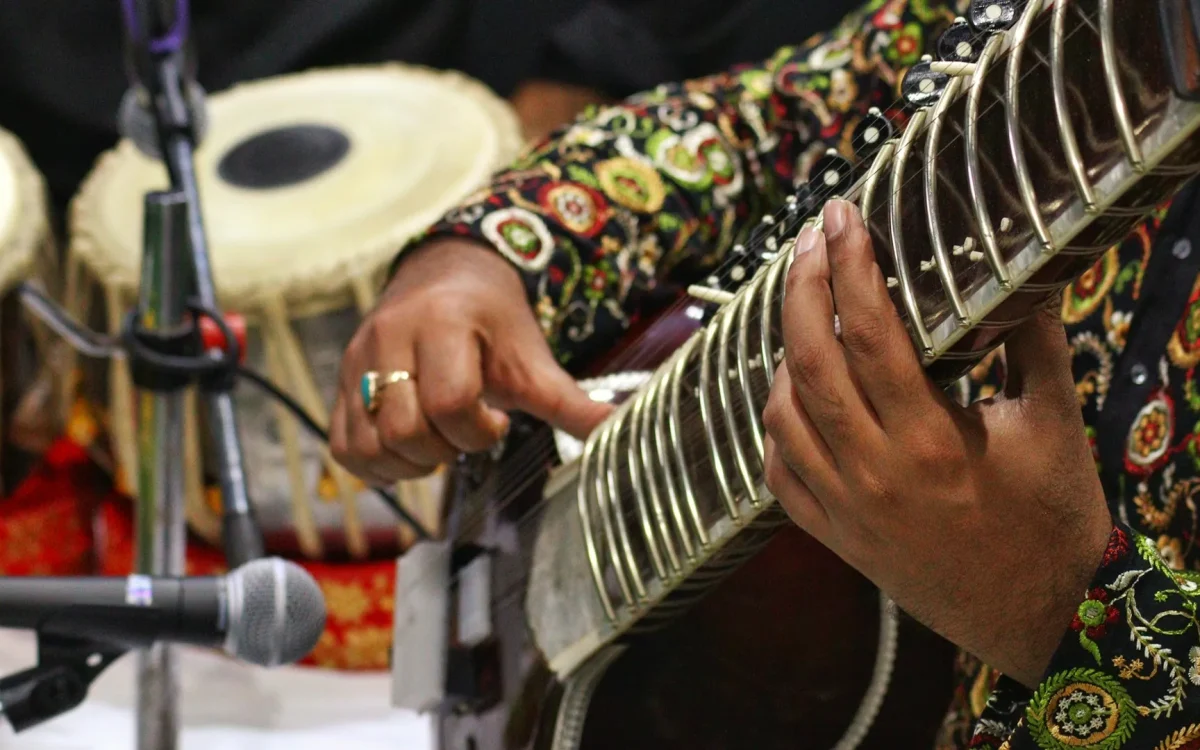
Choose one raga, such as Yaman, and listen to two or three performances by different artists on different instruments. Notice the alap, the arrival of the tabla and the build-up. The World Music Genre Explorer AI can explain specific ragas, and the Global Playlist Curator AI can suggest recordings for different times of day. Read also sitar and tabla.
Frequently asked questions
What is the difference between a raga and a scale?
A raga includes rules for ascent and descent, important notes, characteristic phrases and mood, not just a set of notes.
What is sam in Indian music?
The first beat of the tala cycle, where improvisations resolve.
Why do ragas have times of day?
Tradition associates each raga’s mood with a time or season, such as Bhairav at dawn and Yaman in the evening.
Questions and notes