Hawaiian Music: Ukulele, Slack-Key and Steel Guitar
Hawaiian music runs from ancient chant and hula to the ukulele, slack-key guitar and the steel guitar that changed country music. Its history, its instruments, its great voices and how to hear it beyond the tourist clichés.
In this guide
For many people, Hawaiian music means a gentle ukulele, a sliding steel guitar and swaying hula dancers. Those images are part of the story, but Hawaiian music is much richer: it includes ancient chants that record genealogies and history, drum-accompanied hula, sacred and celebratory songs, a guitar tradition unique to the islands and an instrument, the steel guitar, that shaped American country music. This guide explores Hawaiian music from its roots to today.
Chant: the foundation
Before European contact, Hawaiian music centred on mele, poetic texts that were chanted. Oli are chants performed without dance or instrumental accompaniment, used for prayers, genealogies, greetings and honouring people and places. Chants preserved history and knowledge in a society without writing, and chanters, trained for years, held an important role. The vocal techniques of chant, including a distinctive vibrato called ‘i’i, remain central to Hawaiian music today.
Hula kahiko and hula ‘auana
Hula is the dance that accompanies mele, telling stories through movement of the hands, hips and feet. Hula kahiko, ancient-style hula, is performed to chant with percussion instruments such as the ipu (a gourd drum), the pahu (a sharkskin-covered drum) and rattles. Hula ‘auana, modern hula, developed after Western contact and is accompanied by ukulele, guitar, bass and singing. Each year, the Merrie Monarch Festival in Hilo, held since 1964, brings together the best hula schools, called hālau, for a celebrated competition.
The ukulele
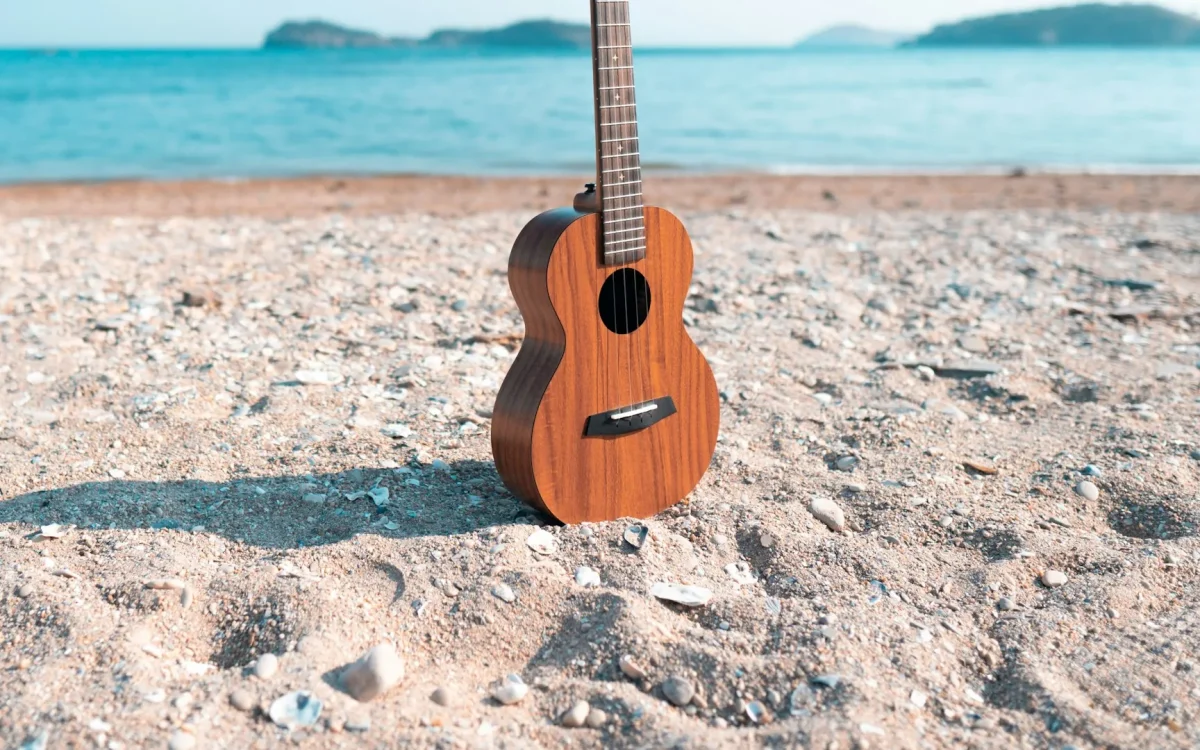
The ukulele came to Hawaii with Portuguese immigrants from Madeira, who arrived in 1879 to work on sugar plantations. Their small four-stringed guitar, the machete or braguinha, quickly became popular, and Madeiran craftsmen such as Manuel Nunes, Augusto Dias and José do Espírito Santo began building instruments in Honolulu. King David Kalākaua, a great supporter of Hawaiian culture, encouraged its use. The name ukulele is often translated as “jumping flea”, possibly describing the movement of fingers on the strings. See best ukuleles for beginners.
Slack-key guitar
Hawaiian slack-key guitar, called kī hō’alu (“loosen the key”), uses open tunings in which some strings are loosened so that the open strings form a chord. Players pick a bass pattern with the thumb while playing melodies on the higher strings, creating a full, flowing sound. Each family traditionally had its own tunings, sometimes kept secret. Gabby Pahinui, active from the 1940s to the 1970s, became a legendary slack-key guitarist and singer, and his recordings helped spark a revival of interest in the style.
| Instrument or style | Origin | Sound |
|---|---|---|
| Ukulele | Portuguese machete, 1879 | Bright, rhythmic strumming |
| Slack-key guitar | Hawaiian adaptation of the guitar | Open tunings, flowing fingerpicking |
| Steel guitar | Joseph Kekuku, late nineteenth century | Sliding, singing tones |
| Ipu and pahu | Traditional percussion | Accompany chant and hula kahiko |
The steel guitar
The Hawaiian steel guitar was developed in the late nineteenth century, and Joseph Kekuku, a student in Honolulu, is usually credited with its invention. Instead of pressing the strings against frets, the player slides a smooth metal bar along the strings, with the guitar lying flat on the lap. This creates smooth, singing glides between notes. Hawaiian musicians toured the United States in the early twentieth century, and a Hawaiian music craze followed the 1915 Panama-Pacific International Exposition in San Francisco. The steel guitar was adopted by country musicians and evolved into the lap steel and pedal steel guitar that define the sound of country music.
Falsetto singing
Hawaiian singers often use falsetto, called leo ki’eki’e, switching between the normal voice and a high, light register. Male falsetto singing is especially admired, with smooth transitions and ornamentation. This style blends traditional chant techniques with influences from Western hymns and cowboy yodelling brought by Mexican and Spanish vaqueros who worked on Hawaiian ranches.
Queen Lili’uokalani
Queen Lili’uokalani, the last monarch of the Hawaiian Kingdom, was also a gifted composer. Her song “Aloha ‘Oe”, written in 1878, became one of the most famous Hawaiian songs in the world. She was overthrown in 1893 by a group of businessmen supported by American forces, and Hawaii was later annexed by the United States. Her music remains a symbol of Hawaiian identity and of the kingdom’s history.
The Hawaiian Renaissance
In the 1970s, a movement known as the Hawaiian Renaissance revived interest in Hawaiian language, culture, hula and music. Musicians returned to traditional styles, wrote songs in Hawaiian and addressed issues such as land rights and sovereignty. Hula schools flourished, and the Hawaiian language, which had been suppressed in schools, began to be taught again.
Israel Kamakawiwo’ole
Israel Kamakawiwo’ole, known as IZ, became the most famous Hawaiian singer of recent times. His gentle voice and ukulele medley of “Somewhere Over the Rainbow” and “What a Wonderful World”, released in 1993, became a worldwide hit and is still heard in films and advertisements. He was also a strong advocate for Hawaiian rights and culture. Today, ukulele virtuosos such as Jake Shimabukuro have taken the instrument to new heights.
A closer look: listening beyond the clichés
To hear Hawaiian music in depth, start with a recording of oli, chant without accompaniment. Then listen to a hula kahiko performance with ipu and pahu, a slack-key guitar recording and a falsetto song. You will hear how the different layers of Hawaiian music, ancient and modern, are connected by language, vocal style and a deep relationship with the land.
Putting it into practice
Listen to a Gabby Pahinui slack-key recording, IZ’s ukulele medley and a performance from the Merrie Monarch Festival. If you play ukulele, try learning a simple Hawaiian song. The Learn a World Instrument Coach AI can suggest a plan, and the Music Culture Storyteller AI can share stories of the islands. See also Pacific Island music.
Frequently asked questions
Where does the ukulele come from?
It developed in Hawaii from a small Portuguese guitar brought by Madeiran immigrants in 1879.
What is slack-key guitar?
A Hawaiian fingerpicking style using open tunings with loosened strings.
Who invented the steel guitar?
Joseph Kekuku, in Hawaii in the late nineteenth century, is usually credited.
Questions and notes