Afrobeat: The Sound Fela Kuti Built
Afrobeat fused highlife, jazz, funk and Yoruba rhythm into long, hypnotic grooves with a political message. Fela Kuti and Tony Allen's creation, how an Afrobeat band works and how its legacy lives on.

In this guide
Afrobeat is music built for both the body and the mind. A tight drum groove locks with interlocking guitars, a bass line circles hypnotically, horns blast powerful riffs, and after several minutes a voice arrives to sing and chant about injustice, corruption and freedom. Created in Nigeria in the late 1960s and 1970s, Afrobeat became one of Africa’s most influential musical styles and a symbol of resistance. This guide explains how Afrobeat came about, how it works and why it still matters.
Fela Kuti
Fela Anikulapo Kuti (1938–1997) was the driving force behind Afrobeat. Born in Abeokuta, Nigeria, into a prominent family (his mother, Funmilayo Ransome-Kuti, was a leading activist), he studied music in London in the late 1950s and early 1960s, where he played jazz and highlife. After returning to Nigeria, and especially after a visit to the United States in 1969 where he encountered the Black Power movement and the funk of James Brown, he developed a new sound that combined African rhythms with jazz and funk and lyrics with a strong political message.
Tony Allen: the engine
Afrobeat would not exist in its classic form without the drummer Tony Allen (1940–2020). Allen created a unique drumming style that combined jazz independence with West African polyrhythm, spreading patterns across the hi-hat, snare and bass drum in a way that sounds both relaxed and endlessly propulsive. Fela said that without Tony Allen there would be no Afrobeat. Allen later had a long career collaborating with musicians around the world.
How an Afrobeat band works
| Instrument | Role |
|---|---|
| Drums | Polyrhythmic groove at the heart of the music |
| Bass guitar | Repeating, circular lines |
| Rhythm guitar | Short, choppy, percussive patterns |
| Tenor guitar | Interlocking single-note patterns |
| Percussion | Shekere, clave sticks, congas |
| Horns | Saxophones and trumpets playing riffs and solos |
| Keyboards | Organ or electric piano adding texture and solos |
| Vocals and chorus | Call-and-response singing, often in Pidgin English |
Each instrument plays a simple part, but together they create a dense, interlocking groove, a principle drawn from West African ensemble music. See African polyrhythm explained.
Long songs and slow builds
Afrobeat songs are often very long, frequently lasting ten minutes or more. They usually begin with the rhythm section establishing the groove, then add horns and instrumental solos before the vocals arrive. This slow build creates a hypnotic, trance-like experience, ideal for dancing and listening. Fela’s recordings often filled an entire side of an LP with a single song.
Music as resistance
Fela used his music to criticise military rule, corruption and the legacy of colonialism, singing in Pidgin English so his message could reach people across West Africa. Songs such as “Zombie” (1976), which mocked the military, angered the authorities. Fela declared his compound in Lagos, the Kalakuta Republic, independent from the state, and in 1977 it was raided and burned by soldiers; his mother was injured and later died. Fela was arrested many times but continued to perform and speak out until his death.
The Shrine
Fela performed at his club, the Afrika Shrine in Lagos, where concerts combined music, political speeches and spiritual elements. After his death, his children Femi and Yeni Kuti opened the New Afrika Shrine, which continues to host concerts, including performances by Femi Kuti and Seun Kuti, who leads his father’s later band, Egypt 80.
Afrobeat’s legacy
Afrobeat has influenced musicians around the world, from jazz and funk players to hip-hop producers who sample Fela’s records. Bands in New York, London, Paris and elsewhere play Afrobeat, and the Broadway musical Fela! introduced his story to new audiences. Afrobeat is different from Afrobeats, the modern West African pop style; see Afrobeats vs Afrobeat.
A closer look: listening to the guitars
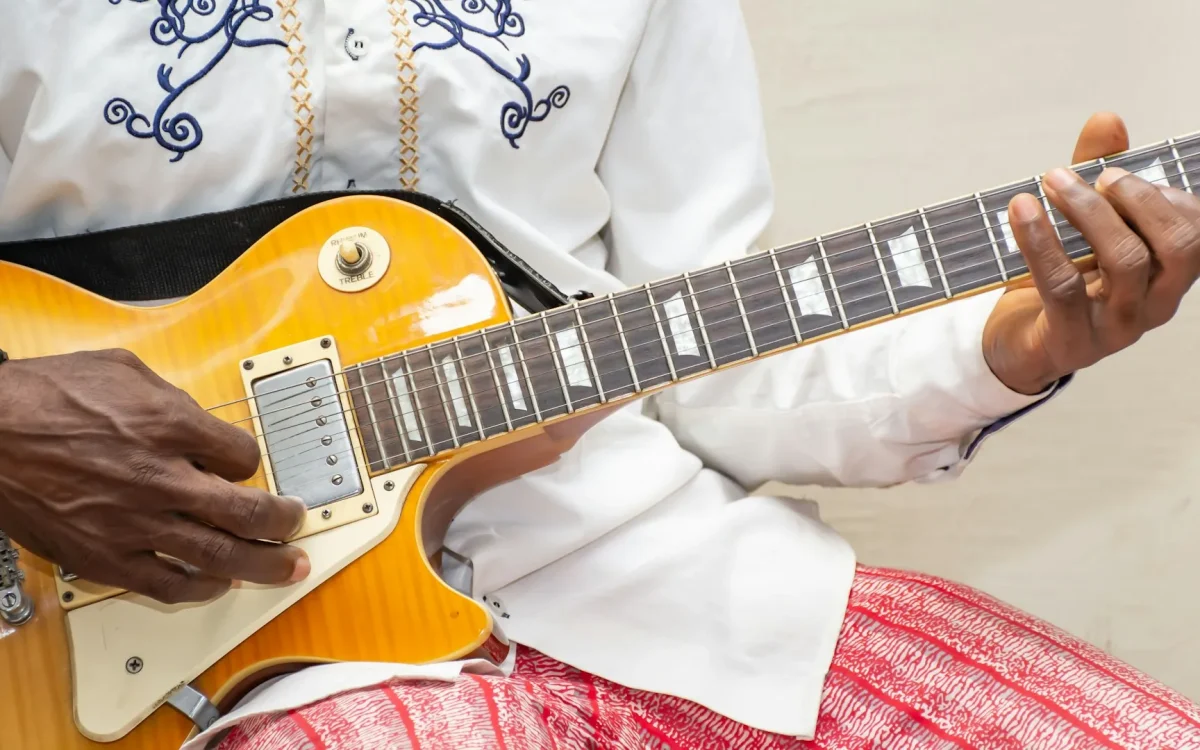
In Afrobeat, the two guitars rarely play chords in the usual way. The rhythm guitar plays short, scratchy chord stabs, while the tenor guitar plays a repeating single-note pattern. Together with the bass, they form an interlocking web. When you listen, try following one guitar for a full minute, then switch to the other. You will discover that each part is simple and repetitive, but their combination creates a constantly shifting texture.
Putting it into practice
Listen to a full-length Fela Kuti track without skipping, and notice how the groove builds before the vocals enter. Then listen to Tony Allen’s drumming on its own if you can find live footage. The World Music Genre Explorer AI can explain Afrobeat’s roots in highlife, and the Global Playlist Curator AI can suggest essential recordings.
Frequently asked questions
Who created Afrobeat?
Fela Kuti, with the drummer Tony Allen, in Nigeria in the late 1960s and 1970s.
Why are Afrobeat songs so long?
The music builds a hypnotic groove gradually, layering instruments before the vocals arrive.
Is Afrobeat the same as Afrobeats?
No. Afrobeats is a modern West African pop style; Afrobeat is Fela Kuti’s 1970s fusion.
Questions and notes