The Mbira: Zimbabwe’s Thumb Piano and Its Spiritual Role
The mbira is a metal-keyed instrument at the heart of Shona spiritual life in Zimbabwe. How it is built, the interlocking kushaura and kutsinhira parts, the all-night bira ceremony and how mbira music shaped modern Zimbabwean pop.
In this guide
The mbira produces a sound like rippling water: bright metal notes, layered and interwoven, with a gentle buzzing halo around them. For the Shona people of Zimbabwe, the mbira is far more than a musical instrument. It is a way to communicate with ancestral spirits, and its music has accompanied ceremonies for centuries. In the twentieth century, mbira music also inspired Zimbabwe’s popular music and became a symbol of national identity. This guide explains how the mbira works, its spiritual role and how to listen.
What is an mbira?
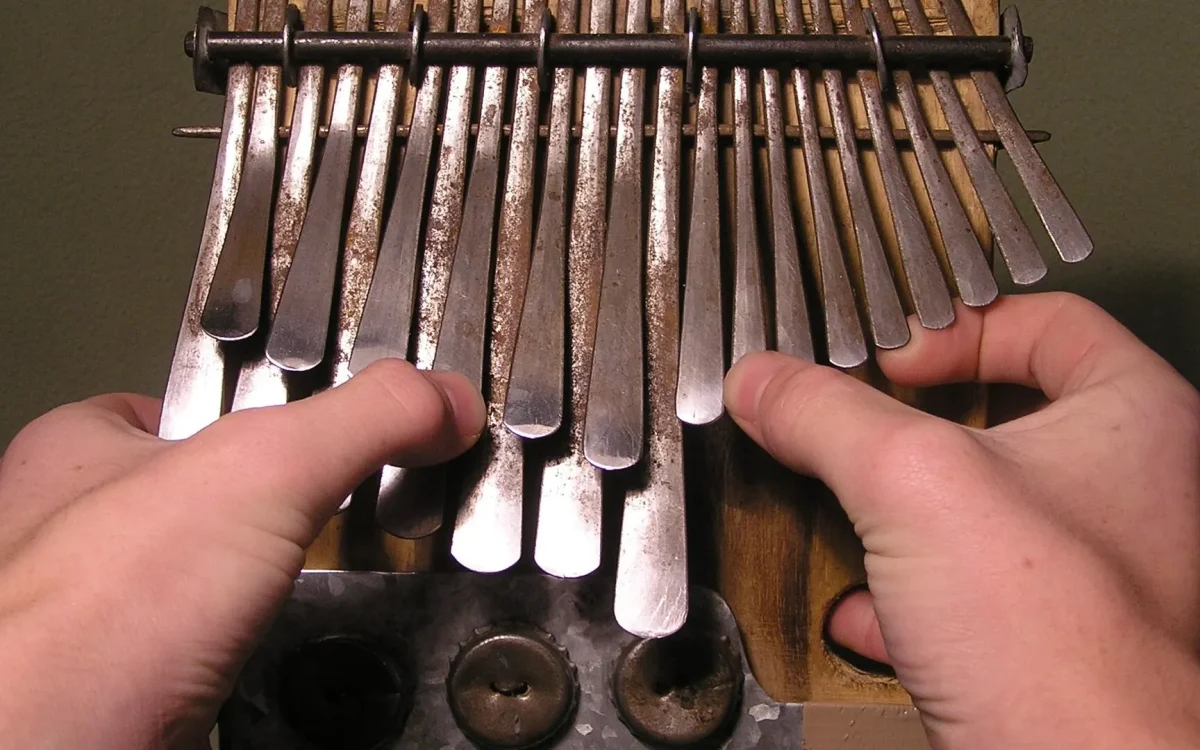
An mbira is a lamellophone, an instrument with metal keys (lamellae) fixed to a wooden soundboard. The player plucks the keys with the thumbs and, on some instruments, the right index finger. The most important type in Shona tradition is the mbira dzavadzimu, meaning “mbira of the ancestors”, which usually has between 22 and 28 keys arranged in three groups or manuals. Lamellophones of many kinds are found across Africa, and the instrument sold around the world as the kalimba is a simplified relative. See learning the kalimba.
Buzz and resonance
Mbira players often place the instrument inside a large calabash resonator called a deze, which amplifies the sound. Bottle caps, shells or small pieces of metal are attached to the soundboard or the resonator so that they buzz when the keys are played. This buzzing is considered an essential part of the sound, adding a shimmering texture that blends the notes together. To Western ears it may sound like a distortion, but to Shona musicians a mbira without its buzz sounds incomplete.
Kushaura and kutsinhira
Mbira music is usually played by at least two players. The first plays the kushaura, the leading part that introduces the piece. The second plays the kutsinhira, an interlocking part that fits between the notes of the kushaura. Together, the two parts create a dense, flowing texture in which new melodies seem to emerge, as the listener’s ear picks out patterns formed by notes from both players. Each piece is a repeating cycle, often of 48 pulses, with variations added by the players over time.
| Element | Role |
|---|---|
| Kushaura | Leading part, introduces the piece |
| Kutsinhira | Interlocking second part |
| Hosho | Gourd shakers playing a steady triple-based rhythm |
| Voices | Singing, yodelling and vocables woven into the texture |
| Hand clapping | Participants add interlocking clap patterns |
The hosho, a pair of gourd shakers filled with seeds, play a steady pattern that holds the ensemble together. See African polyrhythm explained.
The bira ceremony
The most important setting for mbira music is the bira, an all-night ceremony held by a family or community to call on the spirits of ancestors for guidance, healing or help. Mbira players perform for hours, accompanied by hosho, singing, clapping and dancing. At some point, a spirit medium may become possessed by an ancestral spirit, who then speaks to the family. The music is believed to help bring the spirits and the living together, and particular pieces are associated with particular spirits.
Traditional pieces
Mbira players learn a repertoire of traditional pieces, many of them very old, with names such as “Nhemamusasa” and “Nyamaropa”. Each piece has a basic pattern and many variations, and good players develop their own versions over a lifetime. Learning traditionally happens by ear and by watching, often from family members.
Suppression and survival
During the colonial period, missionaries and authorities often discouraged mbira music because of its role in traditional religion. Despite this, the tradition survived in rural communities. From the mid-twentieth century, as the movement for independence grew, mbira music gained new value as a symbol of African identity and resistance.
Chimurenga music
Thomas Mapfumo, one of Zimbabwe’s most famous musicians, developed chimurenga music in the 1970s by adapting mbira patterns to electric guitar and other band instruments, and singing in Shona about the liberation struggle. Chimurenga means “struggle” in Shona. Other bands, including those of Oliver Mtukudzi and the Bhundu Boys, drew on mbira-inspired guitar styles, and electric guitarists imitated the interlocking patterns of the mbira. Mapfumo’s songs were banned by the colonial government, but they became anthems of the independence movement.
Stella Chiweshe and other players
Stella Chiweshe (1946–2023) became internationally known as one of the few women to play mbira professionally in her generation, breaking with tradition and performing around the world. Ephat Mujuru and other players also taught and performed internationally, and the scholar Paul Berliner’s book The Soul of Mbira helped introduce the tradition to readers abroad. In 2020, UNESCO recognised the art of crafting and playing the mbira in Zimbabwe and Malawi as Intangible Cultural Heritage.
A closer look: hearing hidden melodies
When you listen to two mbira players together, try not to follow either player’s part. Instead, let your ear pick out melodies that seem to rise from the combined texture. Mbira players call these inherent patterns, and they can change as you listen, even if the players repeat the same parts. This is one reason mbira music can be listened to for hours without becoming boring.
Putting it into practice
Listen to a traditional recording of mbira music, then a Thomas Mapfumo song, and notice how the guitar imitates the mbira. If you want to play, start with a kalimba, then look for a teacher of Shona mbira. Try our kalimba player, and ask the Learn a World Instrument Coach AI for a practice plan.
Frequently asked questions
Is the mbira the same as the kalimba?
They are related lamellophones; the kalimba is a simplified, commercially produced relative of African instruments such as the mbira.
What is a bira?
An all-night Shona ceremony in which mbira music helps call on ancestral spirits.
Who is Thomas Mapfumo?
A Zimbabwean musician who adapted mbira music to electric bands in his chimurenga style.
Questions and notes