Gnawa Music: Trance, Guembri and Spirit in Morocco
Gnawa is Morocco's hypnotic ritual music, built on the deep three-string guembri and clattering iron qraqeb. Its sub-Saharan roots, the all-night lila ceremony, the Essaouira festival and its meeting with jazz.
In this guide
A deep, woody bass line repeats over and over. Iron castanets clatter in a rolling, swinging pattern. A lead singer calls and a chorus answers, and the music gradually grows more intense as the night goes on. This is Gnawa, the spiritual and ritual music of Morocco, a tradition that grew from the experiences of sub-Saharan Africans in North Africa and became one of the country’s best-loved sounds. Today Gnawa is played in ritual ceremonies, on festival stages and in collaborations with jazz, rock and electronic musicians. This guide explains where it comes from, how it works and how to listen.
Roots across the Sahara
The Gnawa are communities in Morocco descended largely from people from sub-Saharan West Africa, many of whom were brought north across the Sahara over centuries, often through slavery or as soldiers. They kept elements of their musical and spiritual traditions while embracing Islam, especially Sufi practices. Over time, Gnawa music became a distinctive blend of sub-Saharan rhythms, Islamic devotion and Moroccan culture. The songs often refer to the history of displacement and to saints and spirits, and many lyrics mix Moroccan Arabic with words from West African languages.
The guembri
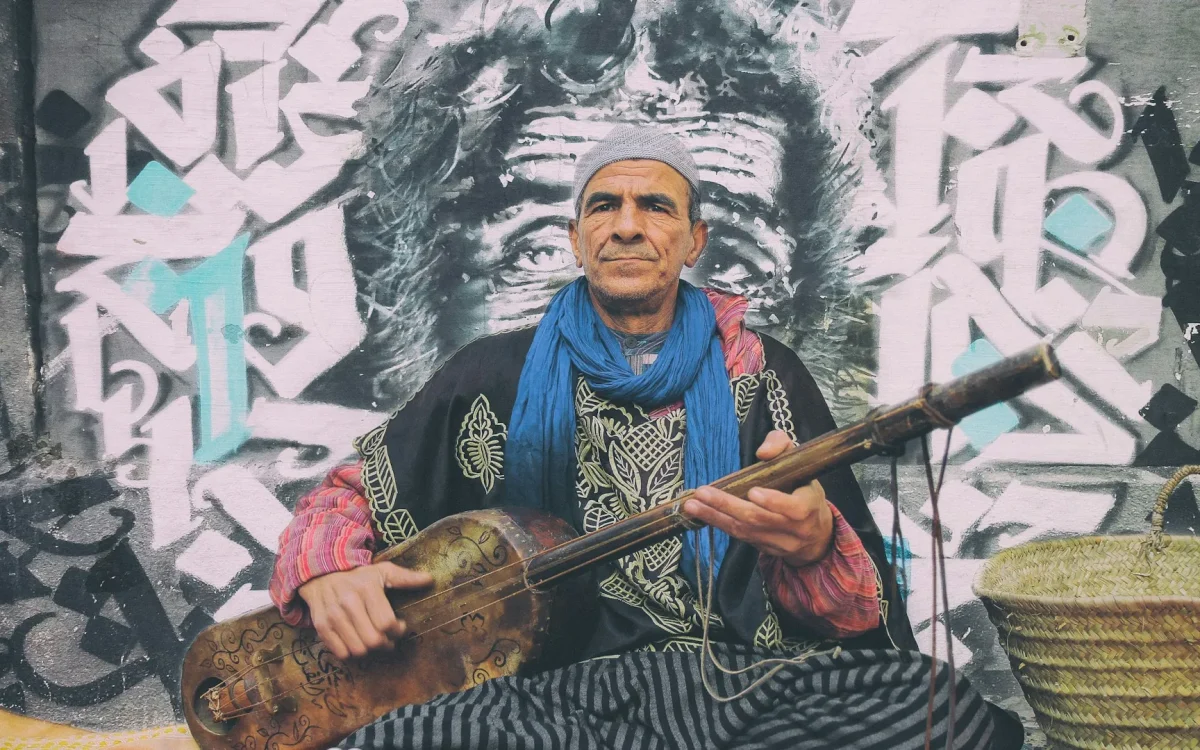
At the heart of Gnawa music is the guembri (also called sintir or hajhouj), a three-stringed bass lute. Its body is carved from a single piece of wood and covered with camel skin, and its strings are traditionally made of goat gut. The player plucks the strings while also tapping the skin, producing both deep bass notes and percussive sounds. The guembri plays repeating melodic and rhythmic patterns that form the foundation of each song. It is played by the maâlem, the master musician who leads the ensemble.
The qraqeb
The qraqeb are large iron castanets, played in pairs in each hand. Several musicians play them together, creating a loud, metallic, galloping rhythm that drives the music forward. The pattern of the qraqeb often sits in a triple-based feel against the guembri’s lines, producing the rolling, swinging groove typical of Gnawa. The qraqeb players also sing the chorus responses and often dance.
The maâlem
A maâlem is a master of Gnawa music and ritual. He has learned the repertoire of songs, rhythms and ceremonies over many years, often from a family member or teacher, and leads both the music and the ritual. Some maâlems became famous far beyond Morocco. Maâlem Mahmoud Guinia from Essaouira, who died in 2015, was among the most celebrated, known for his powerful guembri playing and his collaborations with international musicians.
The lila: a night of healing
The most important context for Gnawa music is the lila, an all-night ceremony of music, dance and trance. A lila is held for healing, blessing or spiritual purposes. It begins with processions and invocations, then moves through a long series of songs, each dedicated to a group of spirits known as mluk. Each group is associated with particular colours, incense and rhythms, and participants may enter a trance state when the music of a spirit they are connected to is played. The ceremony usually continues until dawn, with the maâlem guiding the participants through the sequence.
Colours and spirits
| Element | Role in the lila |
|---|---|
| Colours | Each spirit group has its colour, worn by participants as cloths or garments |
| Incense | Specific incense accompanies each section |
| Songs | Each spirit group has its own songs and rhythms |
| Dance | Participants dance and may enter trance |
| Maâlem | Leads the music and guides the ceremony |
| Moqadma | A female ritual leader who organises the ceremony and assists participants |
The colours and their meanings are part of a complex symbolic system that varies between communities and is passed down orally.
Essaouira and the festival
The coastal city of Essaouira is closely associated with Gnawa music. Since 1998, the Gnaoua World Music Festival has brought hundreds of thousands of visitors to the city each year to hear Gnawa maâlems perform alongside musicians from around the world. The festival’s concerts on open-air stages and its intimate performances in small venues introduced Gnawa to global audiences and encouraged collaborations. See the world’s great music festivals.
Gnawa meets jazz
Gnawa has attracted jazz musicians for decades. The hypnotic repetition and modal character of the music fit naturally with spiritual jazz. The American pianist Randy Weston lived in Morocco and worked with Gnawa musicians, and the saxophonist Pharoah Sanders recorded with Maâlem Mahmoud Guinia in the 1990s. Rock and electronic musicians have also collaborated with Gnawa artists, and younger Moroccan bands blend Gnawa with reggae, rock and hip-hop.
Recognition
In 2019, UNESCO inscribed Gnawa on its list of the Intangible Cultural Heritage of Humanity, recognising it as a set of musical productions, performances, fraternal practices and therapeutic rituals. The recognition reflected both its artistic richness and its role in the identity of Moroccan communities.
A closer look: hearing the groove
To hear what makes Gnawa hypnotic, listen to the qraqeb and the guembri separately. The qraqeb play a repeating pattern that can be counted in groups of three, while the guembri’s lines often suggest a different emphasis. The tension between these layers creates a sense of rolling motion. Try tapping along with the qraqeb, then switching to the guembri’s bass pattern. This kind of layering is common in African music; see African polyrhythm explained.
Putting it into practice
Listen to a recording by a traditional maâlem, then to a festival collaboration with jazz musicians, and notice what stays the same and what changes. If you visit Morocco, look for Gnawa performances in Essaouira or Marrakech, and plan a trip around the festival with the Music Festival Trip Planner AI. The Music Culture Storyteller AI can tell you more about the history and rituals.
Frequently asked questions
What instrument is used in Gnawa music?
The guembri, a three-stringed bass lute, with qraqeb iron castanets and voices.
What is a lila?
An all-night Gnawa ceremony of music, dance and trance, held for healing and blessing.
Where is the Gnawa festival held?
In Essaouira, Morocco, every year since 1998.
Questions and notes