Qawwali: The Devotional Music of the Sufis
Qawwali is the ecstatic devotional music of South Asian Sufism, sung at shrines to bring listeners closer to the divine. Amir Khusrau's legacy, how a qawwali party performs, the poetry and Nusrat Fateh Ali Khan's global voice.
In this guide
A lead singer’s voice soars over a harmonium, the tabla and dholak drive a rhythm and a row of singers clap and repeat a line again and again, each time with more intensity, until the music seems to lift the whole room. This is qawwali, the devotional music of Sufism in South Asia. Sung at shrines, in gatherings and on concert stages, qawwali aims to bring singers and listeners closer to the divine through poetry and music. This guide explains its roots, how it is performed and how to listen.
Sufism and music
Sufism is the mystical tradition within Islam, focused on the direct, personal experience of God’s love. Many Sufi orders use music, poetry and sometimes movement as a means of spiritual remembrance and ecstasy, though attitudes to music vary among Muslims. In South Asia, the Chishti order, which became established in the region from the twelfth and thirteenth centuries, embraced music as part of its devotional practice. Qawwali grew out of this tradition.
Amir Khusrau
Amir Khusrau (1253–1325), a poet, musician and scholar at the court of Delhi and a disciple of the Sufi saint Nizamuddin Auliya, is traditionally credited with shaping qawwali by blending Persian, Arabic, Turkish and Indian musical elements. Many of the songs still sung by qawwals today are attributed to him. His poetry, written in Persian and in the early form of Hindi known as Hindavi, expresses love for the divine and devotion to the spiritual master.
The sama gathering
Traditionally, qawwali is performed at a mehfil-e-sama, a spiritual gathering held at a Sufi shrine (dargah) or other religious setting. Listeners sit and respond to the music, and some may enter a state of spiritual ecstasy. Qawwali is performed especially at the urs, the annual commemoration of a saint’s death, when thousands gather at the shrine. The dargah of Nizamuddin Auliya in Delhi is one of the most famous places to hear qawwali, with performances held regularly in its courtyard.
The qawwali party
| Member | Role |
|---|---|
| Lead singer | Sings the main verses and improvises |
| Second singers | Support and alternate with the lead |
| Chorus | Repeats refrains and claps rhythms |
| Harmonium | Plays melody and supports the voices |
| Tabla and dholak | Provide the driving rhythm |
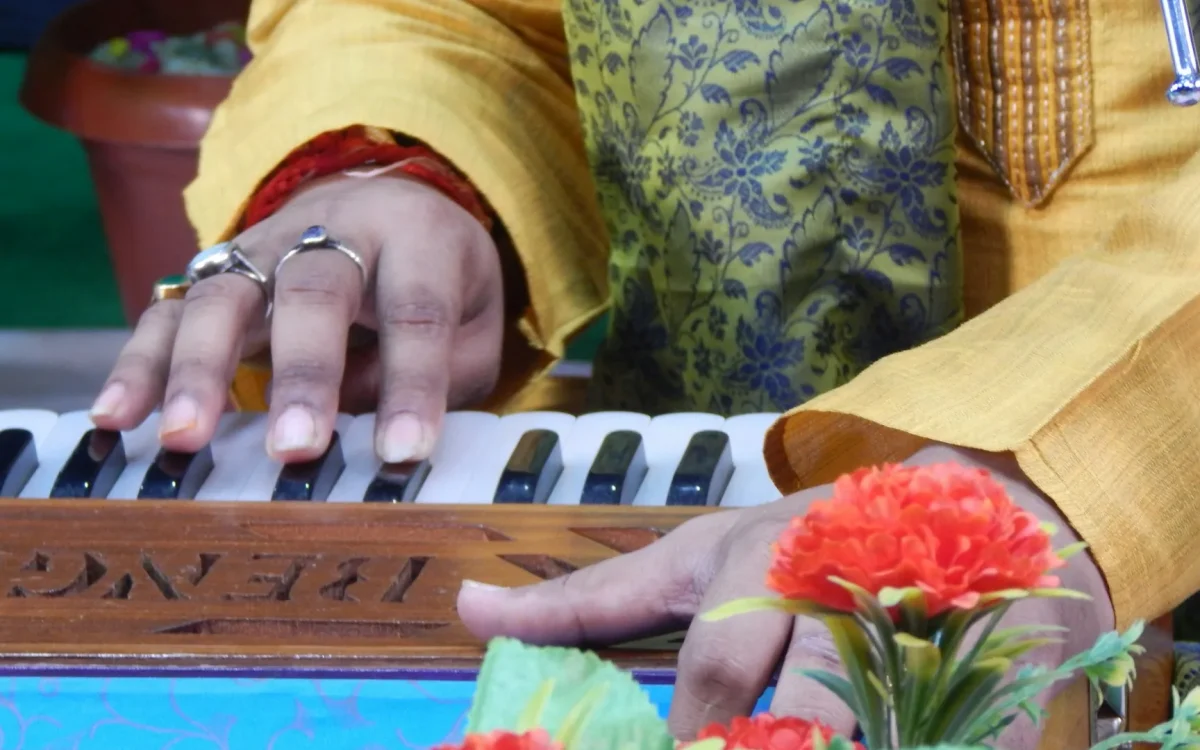
A qawwali group, called a party, usually sits on the floor in a row. The harmonium, a hand-pumped reed organ introduced to South Asia in the nineteenth century, became a standard qawwali instrument in the twentieth century.
Poetry at the heart
Qawwali songs use poetry in Urdu, Persian, Punjabi and Hindi. The poems express love for God, praise for the Prophet Muhammad and devotion to Sufi saints, often using the language of human love, longing and intoxication as metaphors for spiritual experience. A qawwali performance may include a hamd (praise of God), a naat (praise of the Prophet), a manqabat (praise of a saint) and ghazals, love poems interpreted spiritually.
How a qawwali builds
A typical qawwali begins with an instrumental introduction on the harmonium, followed by a slow, unmetered vocal introduction. Then the rhythm begins, and the lead singer presents the verses, with the chorus repeating refrains. As the performance continues, the singers repeat key lines and phrases many times, improvising variations and increasing the tempo and intensity. This repetition is meant to help listeners absorb the meaning of the words and move towards ecstasy. A single qawwali can last twenty minutes or more.
Nusrat Fateh Ali Khan
Nusrat Fateh Ali Khan (1948–1997), from a long family line of qawwals in Pakistan, became the most famous qawwali singer in the world. His extraordinary vocal power, range and improvisational skill amazed audiences. From the 1980s, he performed internationally and recorded for Peter Gabriel’s Real World label, collaborated with Western musicians and contributed to film soundtracks, including Dead Man Walking. His nephew Rahat Fateh Ali Khan continues the family tradition and is popular in film music.
Other great qawwals
The Sabri Brothers, from Pakistan, were celebrated for their powerful qawwali and toured widely. Aziz Mian was known for his intense, philosophical style. In India, many families of qawwals perform at shrines such as Nizamuddin and Ajmer Sharif. Qawwali has also influenced Bollywood music, where qawwali-style songs are a popular genre. See Bollywood film music.
Listening respectfully
If you attend qawwali at a shrine, dress modestly, cover your head if requested, remove your shoes and follow the behaviour of others. Listeners sometimes offer money to the singers as a sign of appreciation, often by approaching and placing notes near the musicians. Remember that for many participants, qawwali is a spiritual practice, not just a concert.
A closer look: the power of repetition
When you listen to a qawwali, notice how a single line is repeated many times. Each repetition may change slightly in melody, rhythm or emphasis, and the chorus responds with growing energy. Rather than becoming boring, the repetition intensifies the emotion. Try listening to an entire long qawwali without skipping, and notice how your attention changes as it builds.
Putting it into practice
Listen to a long live recording by Nusrat Fateh Ali Khan, then a performance by the Sabri Brothers, and compare their styles. The Music Culture Storyteller AI can tell you more about Sufi traditions, and the Global Playlist Curator AI can suggest essential recordings. See also Sufi music and the whirling dervishes.
Frequently asked questions
What is qawwali?
The devotional music of South Asian Sufism, sung to bring listeners closer to the divine.
Who was Nusrat Fateh Ali Khan?
A Pakistani qawwal, considered the greatest qawwali singer of the twentieth century.
What instruments are used in qawwali?
Harmonium, tabla and dholak, with voices and hand clapping.

Questions and notes