Sufi Music: The Sound of the Whirling Dervishes
The whirling dervishes of the Mevlevi order turn to the breath of the ney in a ceremony of spiritual remembrance. Rumi's legacy, the structure and symbolism of the sema, its instruments and music, and Sufi music across the Islamic world.
In this guide
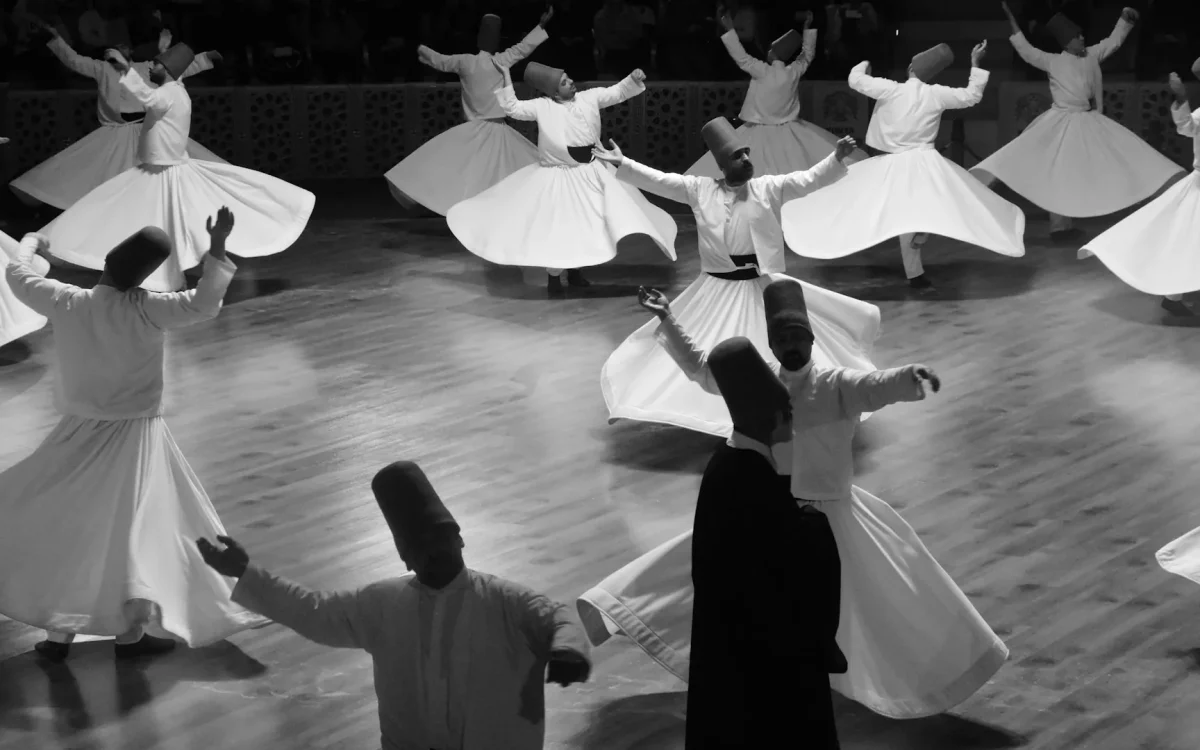
Dressed in white robes and tall felt hats, the dervishes spin slowly, then faster, arms outstretched, one palm turned up to the sky and the other down to the earth. Around them, the breathy sound of the ney flute, the soft beat of small kettle drums and the voices of singers fill the hall. This is the sema of the Mevlevi order, often called the whirling dervishes, one of the most famous expressions of Sufi spirituality. This guide explains the music and meaning of the sema and introduces Sufi music more broadly.
Rumi and the Mevlevi order
Jalal al-Din Rumi (1207–1273), known in Turkey as Mevlana (“our master”), was a Persian-speaking poet, scholar and mystic who lived in Konya, in present-day Turkey. His poetry, especially the Masnavi and his collection of lyric poems, expresses longing for union with the divine and has inspired readers for centuries. After his death, his son Sultan Walad and his followers founded the Mevlevi order, which developed the sema as a form of devotion and remembrance.
The song of the reed
The Masnavi begins with an image of the ney, the reed flute, which laments its separation from the reed bed from which it was cut. The reed’s song expresses the soul’s longing to return to its source. This image made the ney the central instrument of Mevlevi music and a symbol of the human soul. Its breathy tone, produced by blowing across the edge of an open tube, is said to carry the breath of the player and the longing of the spirit.
The sema ceremony
The Mevlevi sema follows a precise structure. It begins with a hymn in praise of the Prophet, sung by a solo singer, followed by a drum strike and an improvised ney solo, or taksim. Then the dervishes walk slowly around the hall three times in a procession, greeting each other. The whirling itself takes place in four sections called selam, each with its own music and meaning, and the ceremony ends with a reading from the Quran and prayers.
| Element | Symbolism |
|---|---|
| Tall felt hat (sikke) | The tombstone of the ego |
| Black cloak (hırka) | The tomb, removed before whirling |
| White skirt (tennure) | The shroud of the ego, and spiritual rebirth |
| Right palm up | Receiving blessing from God |
| Left palm down | Passing blessing to the earth |
| Turning | The movement of the planets and the soul around the divine |
The dervishes, called semazen, turn on the left foot, moving counterclockwise around their own axis and around the hall, guided by a master.
The music
Mevlevi music, called ayin, is one of the most refined forms of Turkish classical music. It is performed by an ensemble that includes the ney, the kudüm (a pair of small kettle drums), the tanbur, the kemençe, the rebab and singers. The music is composed in makam and usul and moves through slow, majestic sections to faster, more intense passages. Composers over centuries, including Mevlevi masters and Ottoman court musicians, wrote ayins, many of which are still performed. See Turkish music.
Şeb-i Arus
Every year in December, the city of Konya hosts ceremonies commemorating Rumi’s death on 17 December 1273. Rumi described death as a reunion with the divine, so the anniversary is called Şeb-i Arus, the “wedding night”. Thousands of visitors attend sema performances and visit Rumi’s tomb, now part of the Mevlana Museum.
Ban and revival
In 1925, the Turkish Republic closed Sufi lodges and banned the activities of Sufi orders as part of its secularisation policies. The sema was later permitted again as a cultural performance, first in Konya in the 1950s, and today it is performed both as a spiritual practice by Mevlevi communities and as a cultural event for visitors. In 2005, UNESCO recognised the Mevlevi sema ceremony as part of the Intangible Cultural Heritage of Humanity.
Watching a sema
If you attend a sema, remember that it is a spiritual ceremony, not a show. Applause is generally not appropriate, and photography may be restricted. Sit quietly and let the music and movement unfold. Many people describe the experience as deeply calming, even without knowing its meaning.
Sufi music across the world
Sufi music takes many forms across the Islamic world. In South Asia, qawwali brings listeners to ecstasy through repetition and poetry; see qawwali. In Morocco, Gnawa and other brotherhoods use music in healing ceremonies; see Gnawa music. In Egypt, singers of inshad perform devotional songs at festivals for saints. In Kurdish communities, large frame drums called daf accompany Sufi gatherings. In Senegal, Sufi brotherhoods have their own devotional songs. Each tradition uses music as a path towards the divine.
A closer look: listening to the ney
When you listen to a ney taksim, notice the breath in the sound, the subtle changes of pitch and the way the player lets notes fade into silence. The ney can express both sorrow and serenity. Imagine the image from the Masnavi: the reed lamenting its separation and longing to return. This image helps explain why the ney is so central to Sufi music.
Putting it into practice
Listen to a complete Mevlevi ayin, then a ney solo and a qawwali by Nusrat Fateh Ali Khan, and compare the different ways Sufi music expresses longing. The Music Culture Storyteller AI can tell you more about Rumi and the Mevlevi order, and the Music Festival Trip Planner AI can help plan a visit to Konya in December.
Frequently asked questions
Who are the whirling dervishes?
Members of the Mevlevi Sufi order, founded by followers of Rumi, who whirl in the sema ceremony.
What instrument is central to Mevlevi music?
The ney, an end-blown reed flute that symbolises the soul’s longing.
When is Şeb-i Arus?
Every December in Konya, culminating on 17 December, the anniversary of Rumi’s death.
Questions and notes