Arabic Maqam Explained: Scales, Quarter Tones and Mood
Maqam is the melodic system of Arabic music, with notes between the keys of a piano and a mood for every mode. Ajnas building blocks, the main maqamat from Rast to Hijaz, taqsim improvisation and the feeling of tarab.
In this guide
Listen to a classical Arabic song and you will hear notes that do not exist on a piano: pitches that fall between a major and a minor third, giving the melody a warm, haunting colour. These notes are part of the maqam system, the framework of melodic modes that underlies Arabic music from Cairo to Baghdad and from Aleppo to Tunis. Each maqam has its own notes, its own melodic paths and its own emotional character. This guide explains the essentials of maqam in plain language, with no musical training required.
What is a maqam?
A maqam (plural maqamat) is a melodic mode. Like a scale, it defines a set of notes, but it also includes rules about which notes are emphasised, how the melody typically moves, where it begins and rests and how it can change to other maqamat. Musicians learn maqamat not as abstract scales but through a repertoire of songs, improvisations and characteristic phrases. Related systems exist in Turkish music (makam) and Persian music (dastgah). See Persian classical music and Turkish music.
Quarter tones
Western music divides the octave into twelve equal semitones. Arabic music uses additional pitches, often described as quarter tones, which lie roughly halfway between two semitones. For example, the note commonly called E half-flat sits between E flat and E natural. Strictly speaking, these intervals are not exact quarter tones, and their precise pitch varies between regions, maqamat and musicians, but the term is a useful simplification. Intervals using these notes are often called neutral intervals, neither major nor minor.
Ajnas: the building blocks
Maqamat are built from smaller units called ajnas (singular jins), groups of three, four or five notes with a characteristic interval pattern. A maqam typically combines a lower jins, which gives the maqam its main character, and an upper jins. The same jins can appear in different maqamat, which helps musicians move between them. Learning to recognise the main ajnas is the key to understanding the system.
The main maqamat
| Maqam | Notable feature | Common mood |
|---|---|---|
| Rast | Neutral third and seventh | Stately, balanced, proud |
| Bayati | Neutral second degree | Warm, earthy, popular |
| Hijaz | Augmented second between second and third degrees | Dramatic, longing, “Eastern” to Western ears |
| Saba | Lowered fourth degree | Sorrowful, intense |
| Nahawand | Similar to the Western minor | Romantic, melancholic |
| Kurd | Similar to the Phrygian mode | Tender, plaintive |
| Ajam | Similar to the Western major | Bright, joyful |
| Sikah | Begins on a neutral note | Mystical, often used in religious chant |
The moods listed are traditional associations, not fixed rules; a skilled musician can express many feelings in any maqam. You can hear Hijaz and other modes in our World Scales Explorer.
Sayr: the melodic path
Each maqam has a sayr, a typical melodic path describing how a melody develops: which note it starts on, which notes it emphasises, how it rises to higher registers and how it returns home. Two maqamat with similar notes may have different sayr, giving them distinct personalities. Experienced listeners can often identify a maqam within a few phrases because of its characteristic path.
Modulation
A distinctive feature of Arabic music is modulation, moving from one maqam to another during a piece or improvisation. Musicians often modulate by changing one jins while keeping another, creating a journey through different moods before returning to the original maqam. Skilful modulation is highly admired, and long performances may pass through many maqamat.
Taqsim: improvisation
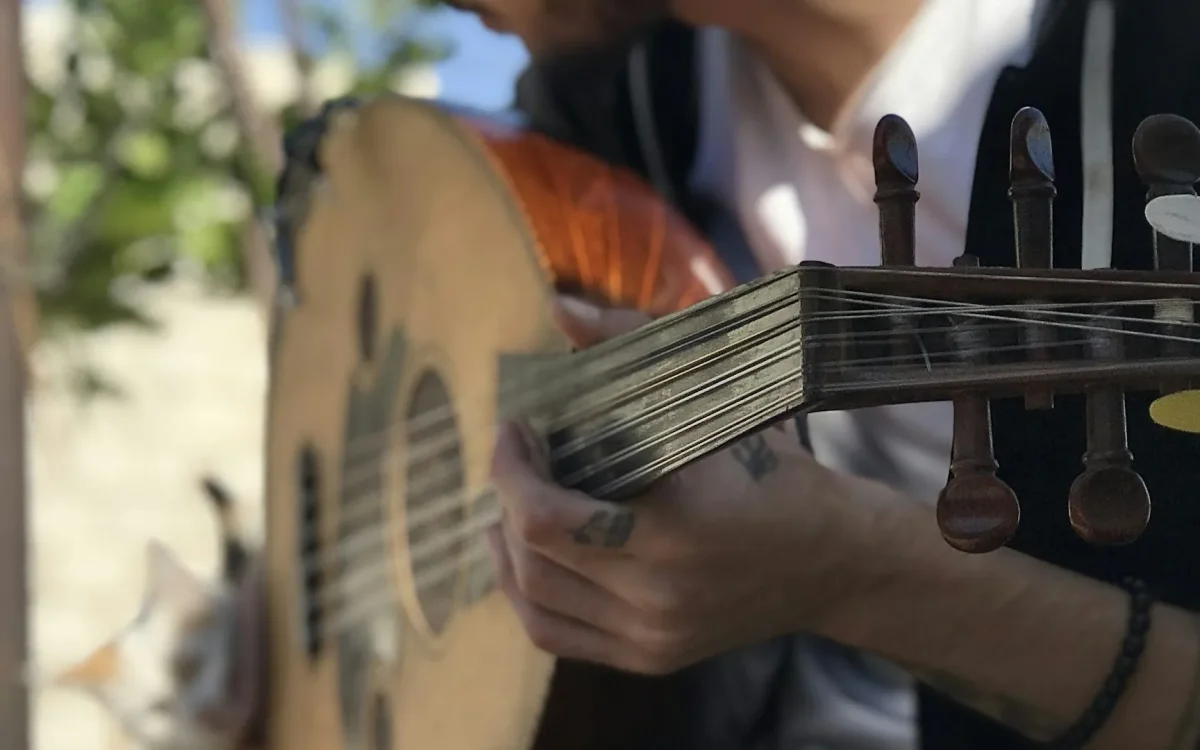
A taqsim is an improvisation, usually without a fixed rhythm, in which a musician explores a maqam and its possible modulations. Taqasim are often played on the oud, qanun, nay or violin, as an introduction to a song or between sections. A good taqsim reveals the maqam step by step, building tension and releasing it, and demonstrates the player’s knowledge and creativity. See the oud.
Tarab: musical ecstasy
Arabic musicians and listeners speak of tarab, a state of emotional transport or ecstasy produced by music. Tarab arises from the interplay of performer and audience: listeners respond with exclamations of appreciation, and the performer responds to their reactions, repeating and varying phrases. The great Egyptian singer Umm Kulthum (1904–1975) was famous for long concerts in which she repeated lines many times, each time with new nuances, bringing audiences to tarab.
Tuning and the 1932 Cairo Congress
In 1932, the Congress of Arab Music in Cairo brought together musicians and scholars from the Arab world and Europe to discuss the theory, tuning and future of Arabic music. One subject was how to describe the intervals of the maqamat. A theoretical division of the octave into 24 equal parts became widely used for notation and teaching, though musicians continue to tune the neutral notes by ear, and actual practice varies.
Instruments and the maqam
Instruments used in Arabic music are designed to produce maqam notes. The oud and violin have no frets, allowing any pitch. The nay, an end-blown reed flute, can bend notes. The qanun, a plucked zither, has small levers called mandal on each course of strings, which allow the player to raise or lower pitches by fractions of a semitone and change maqamat during a performance.
A closer look: hearing the neutral third
To hear what makes maqam Rast distinctive, listen to a recording in Rast and focus on the third note of the scale. It will sound neither major nor minor but somewhere between. At first, it may sound “out of tune” to ears accustomed to Western music, but after a few listens, it reveals a warmth and richness of its own. Compare it with a piece in Ajam, which uses a major third, and notice the difference.
Putting it into practice
Listen to three pieces, one each in Rast, Bayati and Hijaz, and notice how their moods differ. Then listen to a taqsim on the oud and try to follow its journey. The World Music Genre Explorer AI can explain specific maqamat, and our guide to Arabic rhythms explains the rhythmic side of Arabic music.
Frequently asked questions
What is a maqam?
A melodic mode in Arabic music, defining notes, emphasis, melodic paths and mood.
Does Arabic music really use quarter tones?
It uses intervals between semitones, often called quarter tones, though their exact pitch varies.
What is a taqsim?
An unmeasured instrumental improvisation exploring a maqam.


Questions and notes