Persian Classical Music: The Radif, Tar and Santur
Persian classical music is an art of improvisation built on the radif, a vast repertoire of melodies passed from master to student. The dastgah system, poetry and song, the tar, setar, santur and kamancheh, and the great masters.
In this guide
Persian classical music is an intimate, contemplative art. A singer interprets classical poetry with intricate, yodel-like ornaments, a tar or santur responds with delicate phrases, and the music unfolds slowly, guided by a vast repertoire of melodies that musicians spend years memorising. Rather than performing fixed compositions, Persian musicians improvise within a traditional framework, creating music that is both ancient and new each time it is played. This guide explains the radif, the dastgah system, the instruments and how to listen.
The radif
At the heart of Persian classical music lies the radif, a collection of several hundred short melodies, called gusheh, organised into modal groups. The radif was compiled in the nineteenth century, notably by the brothers Mirza Abdollah and Mirza Hossein Gholi, and different masters’ versions have been passed down. Students learn the radif by heart from a teacher, absorbing its melodies, ornaments and phrasing. Once they have mastered it, they use it as a foundation for improvisation. In 2009, UNESCO recognised the radif as Intangible Cultural Heritage.
Dastgah and avaz
The radif is organised into seven main modal systems, called dastgah, and five secondary systems, called avaz, which are derived from them. Each dastgah begins with an introductory section that establishes its mode and moves through a sequence of gusheh, some of which modulate to related modes, before returning home.
| Dastgah | Associated character |
|---|---|
| Shur | Melancholic, the “mother” of several avaz |
| Homayun | Majestic, with an augmented second |
| Segah | Tender, plaintive |
| Chahargah | Strong, festive, heroic |
| Mahur | Bright, similar to the major mode |
| Rast-Panjgah | Rich in modulations |
| Nava | Calm, reflective |
The five avaz, Abu Ata, Bayat-e Tork, Afshari, Dashti and Bayat-e Esfahan, are derived from Shur and Homayun and have their own distinctive moods.
Intervals
Persian music uses intervals that fall between Western semitones. In the early twentieth century, the musician Ali-Naqi Vaziri introduced the symbols koron and sori to notate notes lowered or raised by a fraction of a tone. As with Arabic music, the exact sizes of these intervals vary according to mode and tradition. See Arabic maqam.
Improvisation
A Persian classical performance is largely improvised. A singer or instrumentalist chooses a dastgah and moves through its gusheh, interpreting them freely, combining them with composed pieces and adding personal ornaments. Performances often include an instrumental prelude (pishdaramad), unmetered vocal and instrumental sections, a metric song (tasnif) and a fast instrumental piece (reng). The musician’s skill lies in their ability to create something new within the tradition.
Poetry and song
Persian classical singing, called avaz, is inseparable from poetry. Singers interpret the verses of great Persian poets such as Hafez, Rumi, Saadi and Khayyam, choosing poems that suit the mood of the dastgah. A distinctive feature of Persian singing is tahrir, a rapid, yodel-like ornament produced by breaking the voice between registers. The singer and instrumentalist often alternate, the instrument answering each vocal phrase.
The instruments
| Instrument | Type | Character |
|---|---|---|
| Tar | Long-necked lute with a double-bowl body and skin top | Bright, brilliant |
| Setar | Small long-necked lute with four strings | Soft, intimate, meditative |
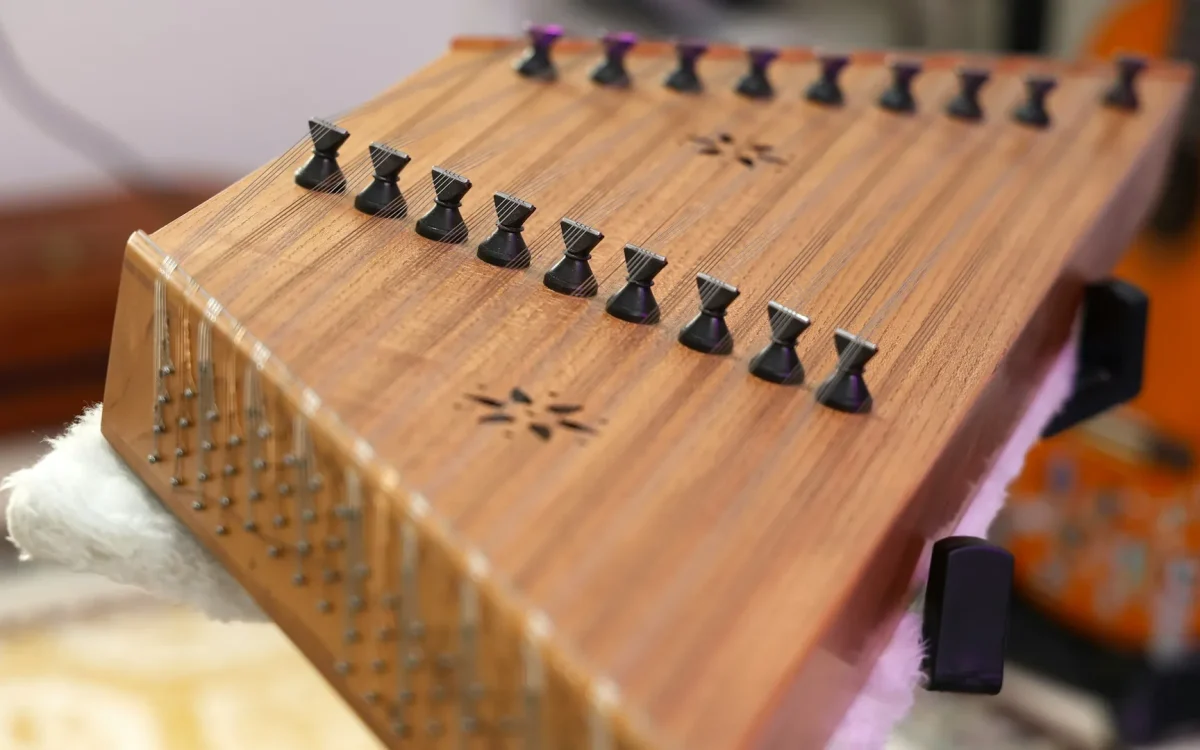
| Santur | Hammered dulcimer with many strings, struck with light mallets | Shimmering, crystalline |
| Kamancheh | Spike fiddle played upright | Expressive, vocal |
| Ney | End-blown reed flute | Breathy, spiritual |
| Tombak | Goblet drum | Rich, complex rhythms |
| Daf | Large frame drum with rings | Deep, resonant, often in Sufi music |
The name setar means “three strings”, although the instrument now usually has four. See also Middle Eastern percussion.
Great masters
Mohammad-Reza Shajarian (1940–2020) was the most celebrated Persian classical singer of his generation, admired for his voice, his mastery of the radif and his independence. Hossein Alizadeh, a master of the tar and setar, is known for his performances and compositions. Kayhan Kalhor, a virtuoso of the kamancheh, has performed worldwide and collaborated with musicians from other traditions, including the Silk Road Ensemble. Faramarz Payvar was an influential santur player and teacher. Many other masters have shaped the tradition.
Persian music in the world
Persian classical music is performed in Iran, Afghanistan, Tajikistan and by communities in exile, especially in Europe and North America. It has influenced and been influenced by Turkish, Arabic and Central Asian music. Contemporary Iranian musicians also blend classical music with jazz, rock and electronic styles.
A closer look: listening for the dialogue
When you listen to a Persian classical recording with a singer and an instrumentalist, notice how the instrument repeats or answers the singer’s phrases, a technique called javab-e avaz (“answer to the song”). Then listen for the tahrir in the singer’s voice, the rapid breaks that give Persian singing its emotional intensity.
Putting it into practice
Listen to a performance by Mohammad-Reza Shajarian, a solo setar improvisation by Hossein Alizadeh and a kamancheh recording by Kayhan Kalhor. The World Music Genre Explorer AI can explain the dastgah system, and the Instrument Origins Guide AI can tell you more about the santur and tar.
Frequently asked questions
What is the radif?
The traditional repertoire of melodies on which Persian classical music is based.
What is a dastgah?
One of the seven main modal systems of Persian classical music.
What is the difference between the tar and setar?
The tar is larger, with a double-bowl body and skin top; the setar is smaller and quieter, with four strings.
Questions and notes