Middle Eastern Percussion: Darbuka, Riq and Daf
From the crisp goblet drum to jingling tambourines and great frame drums, percussion drives the music of the Middle East and North Africa. The darbuka, riq, daf, bendir, tabl and finger cymbals, and how they are played.
In this guide
Percussion is the pulse of Middle Eastern and North African music. The crisp, ringing strokes of the darbuka, the delicate shimmer of the riq, the deep resonance of large frame drums and the booming of outdoor drums accompany classical ensembles, Sufi ceremonies, weddings, belly dance and street celebrations. Each instrument has its own techniques and traditions, and together they create a rich world of rhythm. This guide introduces the most important percussion instruments of the region and how they are played.
The darbuka
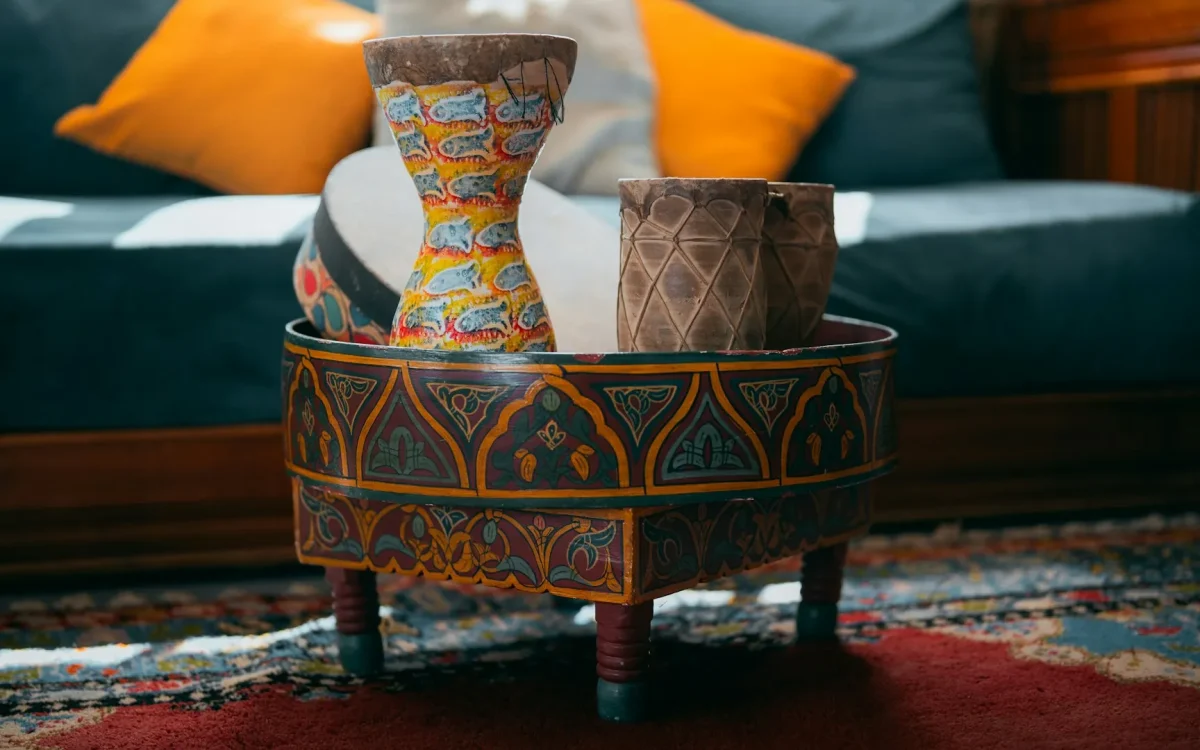
The darbuka, also called doumbek, tabla (in Egypt) or darbouka, is a goblet-shaped drum held under the arm or across the lap. Traditionally made of clay or wood with a goat or fish skin head, today it is often made of aluminium or copper with a synthetic head, which produces a bright, sharp sound. The darbuka is used in Arabic, Turkish, Persian, Balkan and North African music, from classical ensembles to pop and belly dance. See learning the darbuka.
Doum, tek and ka
| Stroke | How it is played | Sound |
|---|---|---|
| Doum | Strong hand strikes near the centre of the head | Deep, resonant bass |
| Tek | Fingers of the strong hand strike the edge | High, sharp crack |
| Ka | Fingers of the other hand strike the edge | High, sharp crack, similar to tek |
| Slap | Hand slaps the head with cupped fingers | Explosive accent |
| Rolls | Rapid finger strokes | Continuous texture |
Rhythms are learned using these syllables. For example, the maqsoum rhythm can be spoken as “doum tek-tek doum tek”. See Arabic rhythms for beginners.
The riq
The riq is a small, heavy tambourine with a skin head, traditionally fish or goat skin, and sets of brass jingles set into the wooden frame. Despite its size, it is a sophisticated instrument, played with precise finger strokes on the head and jingles. In classical Arabic ensembles, the riq player often keeps the rhythmic cycle and adds intricate ornamentation. Skilled riq players can produce an extraordinary range of sounds, from soft shimmers to sharp accents.
Frame drums: daf, bendir and tar
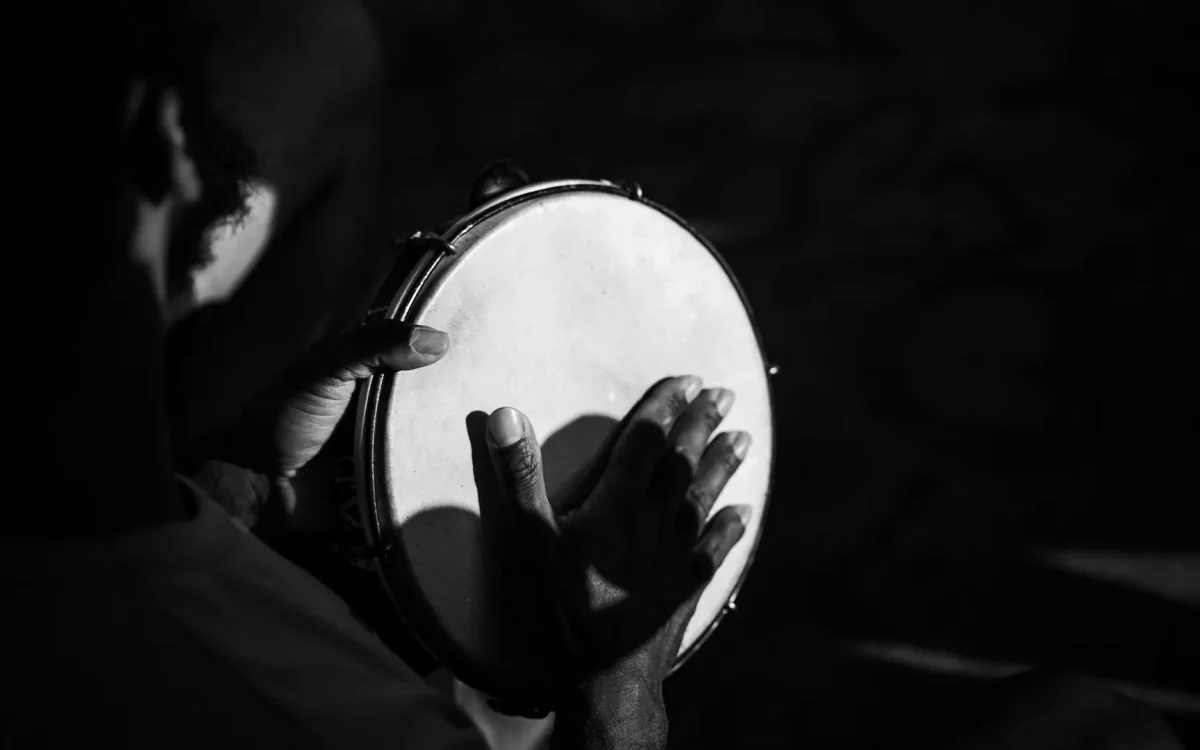
Frame drums, with a skin stretched over a wide, shallow wooden frame, are among the oldest drums in the region. The daf, a large frame drum often with metal rings attached inside the frame, is used in Persian, Kurdish and Sufi music, producing a deep tone with a jingling shimmer. The bendir, common in North Africa, has snares stretched beneath the skin, giving it a buzzing sound, and is used in Sufi and folk music. The tar is a frame drum without jingles. Players hold the drum with one hand and strike it with the fingers of both hands. See frame drums of the world.
The tabl and davul
The tabl (in Arabic) and davul (in Turkish) are large double-headed drums played with sticks, one heavy stick for the bass head and a thin switch for the other. Their powerful sound carries outdoors, and they are played at weddings, festivals and processions, often with the zurna, a loud double-reed instrument. The combination of davul and zurna is a classic sound of celebrations across Turkey, the Balkans and the Middle East.
Kettle drums: naqqara and kudüm
Small kettle drums, played in pairs with sticks, are used in several traditions. The naqqara appears in North African and Middle Eastern ensembles and gave its name to the medieval European nakers. In Turkish classical and Mevlevi Sufi music, the kudüm, a pair of small kettle drums, marks the rhythmic cycles. Larger kettle drums were part of Ottoman military bands. See Sufi music and the whirling dervishes.
Finger cymbals
Finger cymbals, called zills in Turkish and sagat in Arabic, are small metal cymbals worn on the thumb and middle finger of each hand. Belly dancers often play them while dancing, adding bright rhythmic patterns to the music. Musicians in ensembles may also play them.
Rhythmic modes
Middle Eastern music organises rhythm into cycles called iqa’at in Arabic and usul in Turkish. Each cycle has a pattern of strong and weak beats, combinations of doum and tek, and players decorate the basic pattern with fills and variations. Some cycles are short and common, such as the maqsoum and baladi, while others, used in classical music, can be very long and complex.
Great percussionists
Many virtuoso percussionists have brought Middle Eastern drums to international audiences. The Egyptian percussionist Hossam Ramzy worked with musicians from many genres, including rock artists, and recorded many albums of Egyptian rhythms. Turkish darbuka players developed innovative techniques, such as the split-finger technique, which allows very fast and complex patterns. Today, darbuka and frame drum players perform in classical, folk, jazz and fusion contexts around the world.
A closer look: learning by voice
Middle Eastern drummers often learn rhythms by speaking them before playing. Try saying “doum tek-tek doum tek” slowly, then clap on “doum” with your strong hand and tap on “tek” with your fingers on a table. Once comfortable, speed up. This simple exercise introduces you to the maqsoum, one of the most common rhythms. You can hear it in our World Rhythm Machine.
Putting it into practice
Listen to a classical Arabic ensemble with riq, a Persian daf performance and a darbuka solo, and compare their sounds. If you want to play, a darbuka is an excellent first instrument; see our best darbukas guide. The World Rhythm Coach AI can guide you through rhythms step by step.
Frequently asked questions
What is a darbuka?
A goblet-shaped hand drum used across the Middle East, North Africa and the Balkans.
What are doum and tek?
The basic darbuka strokes: doum is the deep centre sound, tek the sharp edge sound.
What is the difference between a riq and a daf?
The riq is a small tambourine with jingles; the daf is a large frame drum, often with rings inside.


Questions and notes