The Oud: The Lute at the Heart of Arabic Music
The oud is the short-necked, fretless lute at the centre of Arabic, Turkish and Persian-influenced music, and the ancestor of the European lute. How it is built, how it is played, its legends and its greatest masters.
In this guide
The oud is often called the king of Arabic instruments. Its warm, deep, slightly percussive sound has accompanied singers, poets and dancers across the Middle East, North Africa, Turkey, Armenia, Greece and Central Asia for more than a thousand years. With its rounded body and short, fretless neck, the oud can produce the subtle pitches of the maqam system and both delicate melodies and powerful rhythms. It is also the ancestor of the European lute. This guide explains the oud’s history, construction and playing, and introduces some of its greatest masters.
Ancient origins
Lutes with short necks and rounded bodies appear in images from ancient Mesopotamia, Persia and Egypt, and the oud probably developed from instruments like the Persian barbat. By the early centuries of Islam, the oud was well established in the Arab world, where it became the central instrument of music theory and practice. Scholars used the oud to explain intervals and modes, and it was played at the courts of Damascus, Baghdad and Córdoba. The word oud comes from the Arabic al-‘ud, meaning “the wood”.
Ziryab
A legendary figure in the history of the oud is Ziryab, a ninth-century musician who, according to tradition, trained in Baghdad and moved to Córdoba in Al-Andalus, Muslim Spain. There he is said to have founded a music school, introduced new fashions and added a fifth course of strings to the oud. Many stories about him are legendary, but he remains a symbol of the flourishing music culture of Al-Andalus. See Andalusian music.
From oud to lute
Through contact between the Islamic world and Europe, especially in Spain and Sicily, the oud travelled to Europe in the Middle Ages, where it became the lute. The European word lute, like the Spanish laúd, comes from the Arabic al-‘ud. The lute became one of the most important instruments of the European Renaissance, before frets were added and the instrument evolved in different directions.
How the oud is built
| Part | Description |
|---|---|
| Bowl | Rounded back made of many thin wooden ribs |
| Soundboard | Thin top with one or more carved rosettes |
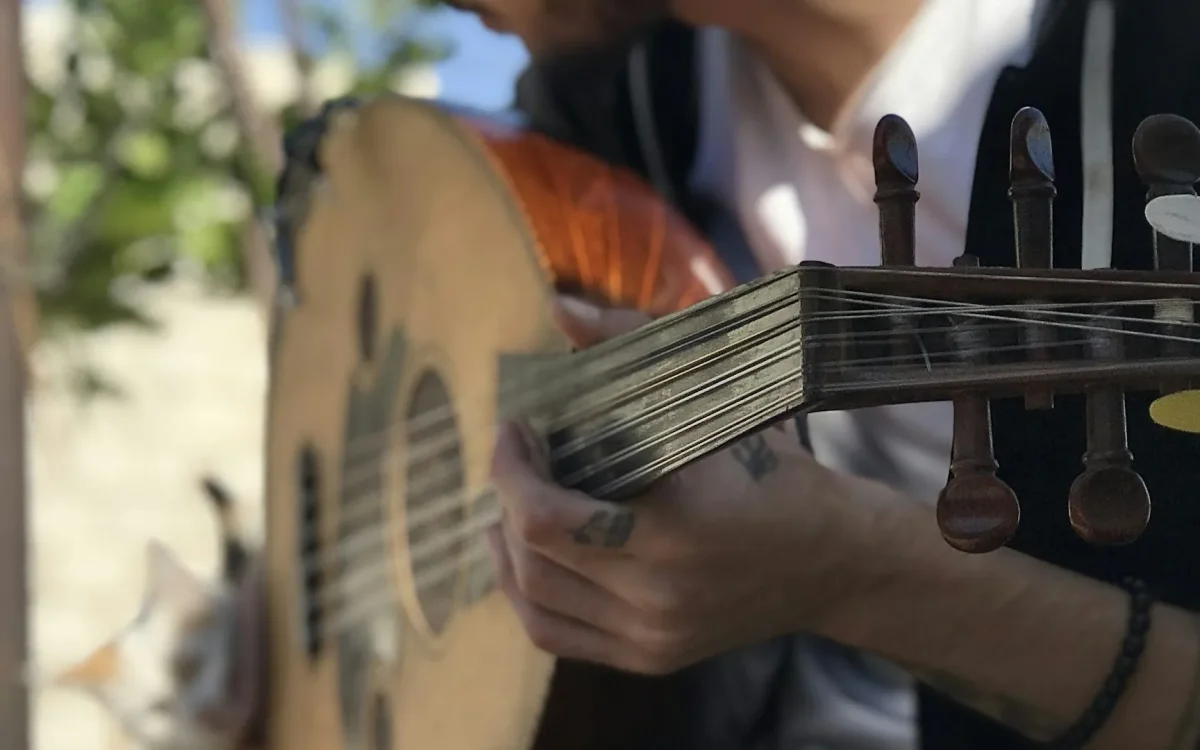
| Neck | Short and fretless, allowing any pitch |
| Pegbox | Bent back at a sharp angle |
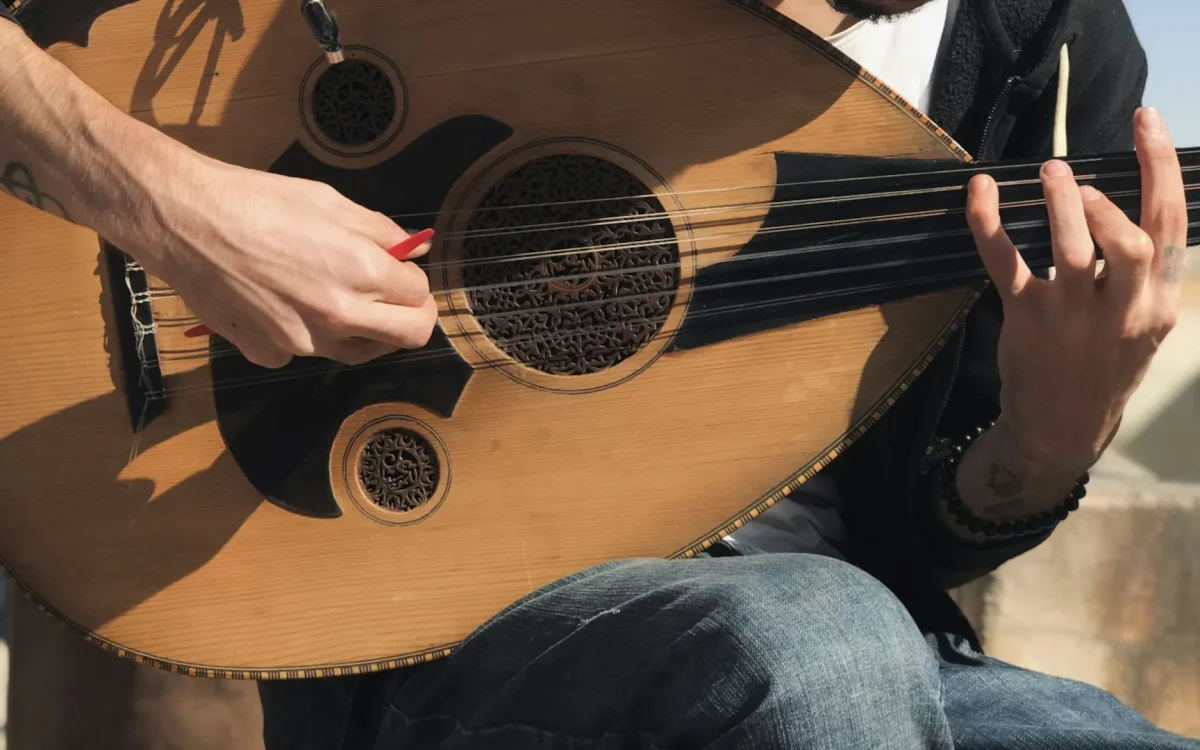
| Strings | Usually eleven: five double courses and a single bass string |
| Risha | A long plectrum, traditionally made of an eagle feather, today plastic |
Oud makers, especially in Syria, Iraq, Egypt and Turkey, are highly respected craftsmen. The choice of woods, the thinness of the soundboard and the shape of the bowl all affect the instrument’s tone.
Fretless freedom
The oud has no frets, which allows the player to play the neutral intervals and subtle pitch variations of the maqam system. It also allows slides and vibrato, giving the oud a vocal quality. However, playing without frets requires a well-trained ear to play in tune. See Arabic maqam explained.
Arabic and Turkish ouds
There are two main types of oud. The Arabic oud is generally larger, with a deeper, warmer tone and longer scale. The Turkish oud is slightly smaller, with a brighter sound and usually tuned higher. Persian music uses a related instrument, the barbat, and Armenian, Greek and other traditions have their own playing styles. Players choose their oud according to their repertoire and personal taste.
Playing the oud
The oud is played with the risha held in the right hand, using down and up strokes, tremolo and rapid passages. The left hand presses the strings, producing notes, slides and vibrato. Oud players perform composed pieces, accompany singers and improvise taqasim. In the traditional Arabic ensemble called the takht, the oud plays with the qanun, nay, violin and riq, a small tambourine, accompanying a singer.
Great oud masters
Many Arabic singers and composers of the twentieth century were also fine oud players, including Mohammed Abdel Wahab, Riad Al Sunbati and Farid al-Atrash, whose instrumental passages were admired across the Arab world. Munir Bashir (1930–1997), from Iraq, was celebrated for his solo improvisations and helped establish the oud as a concert instrument. Naseer Shamma, also from Iraq, has developed new techniques and founded oud schools. Anouar Brahem from Tunisia and Rabih Abou-Khalil from Lebanon have combined the oud with jazz and other styles.
The oud today
The oud is played in classical Arabic music, Turkish music, folk music, film soundtracks and fusion projects with jazz, flamenco, classical and electronic musicians. Oud schools and festivals exist across the Middle East and in Europe, and the instrument has attracted learners from around the world.
A closer look: listening to a taqsim
When you listen to a solo oud taqsim, notice how the player starts with low, slow phrases, gradually explores higher notes and builds intensity. Listen for slides between notes and for passages where the player changes maqam. A taqsim tells a story in sound, and each player’s style is unique.
Putting it into practice
Listen to a Munir Bashir solo recording, an Anouar Brahem album and a classical Arabic song with oud accompaniment. If you want to learn, find a teacher, as the oud’s fretless neck requires guidance. The Learn a World Instrument Coach AI can suggest a plan, and the Instrument Origins Guide AI can tell you more about its history.
Frequently asked questions
Is the oud related to the lute?
Yes. The European lute descends from the oud, and its name comes from the Arabic al-‘ud.
Why does the oud have no frets?
So that players can produce the subtle intervals of the maqam system and expressive slides.
How many strings does an oud have?
Usually eleven, in five double courses plus a single bass string.

Questions and notes