The Sitar: How It Works and Why It Sounds That Way
The sitar's shimmering buzz and singing glides come from clever acoustics: a curved jawari bridge, sympathetic strings and high, movable frets. How each part works, how the strings are tuned, the different playing styles and the sitar's place in pop.
In this guide
The sitar is one of the most recognisable instruments in the world, with its long neck, large gourd and shimmering, buzzing tone. But what gives it that unique sound? The answer lies in a combination of clever design features: a specially shaped bridge that makes the strings buzz, sympathetic strings that ring on their own and curved frets that allow notes to glide like a voice. This guide explains how the sitar works and why it sounds the way it does.
The parts of the sitar
| Part | Name | Function |
|---|---|---|
| Resonator | Tumba | Dried gourd that amplifies the sound |
| Soundboard | Tabli | Thin wooden top that vibrates |
| Neck | Dandi | Long hollow neck carrying the frets |
| Frets | Parda | Curved, movable metal frets |
| Main bridge | Jawari | Wide, curved bridge that creates the buzz |
| Sympathetic strings | Taraf | Strings beneath the frets that resonate |
| Upper gourd | Tumbi | Optional second resonator near the top |
Three kinds of strings
A sitar typically has six or seven playing strings and eleven to thirteen sympathetic strings. The main melody string, called the baj tar, carries most of the melody and is the one the player bends. Other playing strings provide additional melody notes and drones in lower registers. The chikari strings, two or three thin, high-pitched strings, are struck rhythmically to provide a drone and rhythmic punctuation. The sympathetic strings, or taraf, run beneath the frets and are not usually played directly.
The jawari: the secret of the buzz
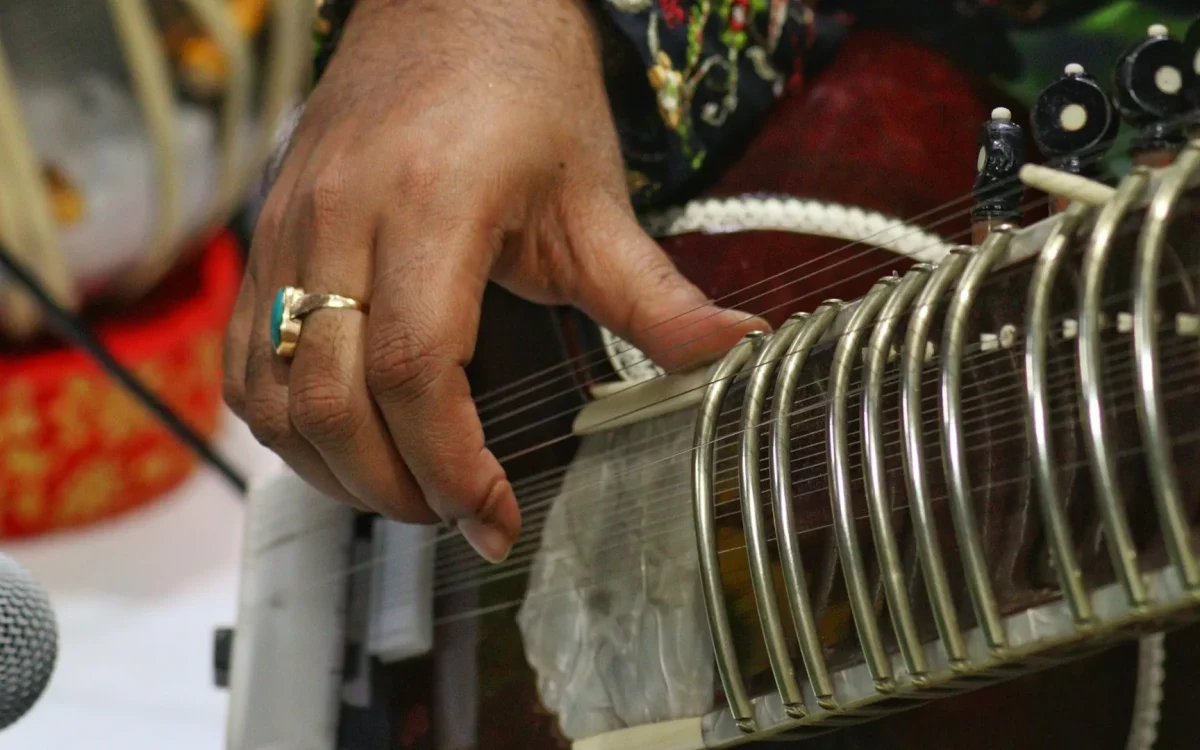
The jawari is the key to the sitar’s sound. Unlike the narrow bridge of a guitar or violin, the jawari has a wide, gently curved surface. As a string vibrates, it repeatedly touches and leaves this curved surface, which constantly changes the effective vibrating length of the string. This produces a sound rich in high overtones, heard as a bright, buzzing shimmer that evolves as the note fades. Shaping the jawari is a delicate art, and sitar players and makers adjust it carefully to achieve the desired tone, from an open, buzzing sound to a more closed, refined one.
Sympathetic resonance
The sympathetic strings are tuned to the notes of the raga being played. When the player plucks a note on a main string, any sympathetic string tuned to the same pitch or a related pitch begins to vibrate on its own, without being touched. Each sympathetic string also passes over its own small jawari, so it too produces a shimmering tone. The result is a halo of resonance that surrounds every note and continues after it. Because the sympathetic strings must be retuned for each raga, sitar players spend time tuning before performances.
Curved frets and meend
The sitar’s frets are curved metal arches, tied to the neck with cords so they can be moved to adjust the tuning for different ragas. They are high above the neck, which allows the player to pull the string sideways across the fret to raise its pitch, a technique called meend. A skilled player can bend a note by several steps, gliding smoothly between pitches. This allows the sitar to imitate the ornaments and slides of Indian classical singing, which is the model for all Indian instruments. See raga and tala.
The mizrab
The player plucks the strings with a mizrab, a wire plectrum worn on the index finger of the right hand. Strokes towards the player and away from the player produce different sounds and are combined into rhythmic patterns. The chikari strings are often struck with the little finger or the mizrab to add rhythmic accents.
Tuning to the raga
Before playing, the sitarist tunes the main strings to the tonic (Sa) and fifth (Pa) or fourth (Ma) of the raga, and the sympathetic strings to the notes of the raga’s scale. They may also adjust the positions of certain frets so that notes match the raga’s exact intervals. This careful preparation ensures that the sympathetic strings resonate with the notes that will be played most often.
Playing styles
Two main styles of sitar playing developed in the twentieth century. Ravi Shankar’s style used a sitar with additional bass strings, allowing deep, resonant passages in the alap. Vilayat Khan’s style emphasised a singing approach, called gayaki ang, imitating the human voice with long meend, and used a sitar without the lowest bass strings. Both styles have many followers today. See sitar and tabla.
History
The origins of the sitar are debated. A popular legend credits the thirteenth-century poet Amir Khusrau with its invention, but most scholars believe the sitar developed in the eighteenth century, combining elements of the Persian setar and Indian stringed instruments. Its name may come from the Persian seh tar, meaning “three strings”. Over the nineteenth and twentieth centuries, the sitar grew in size, gained more strings and became the leading instrument of Hindustani music. A larger bass version, the surbahar, is used for slow, deep playing.
The sitar in pop
In the 1960s, the sitar became famous in Western pop music after George Harrison played it on the Beatles’ “Norwegian Wood”. Many rock bands experimented with the sitar, and an electric sitar, a guitar fitted with a special bridge that imitates the jawari buzz, was introduced in 1967 and used on many recordings.
A closer look: hearing the shimmer
Listen to a single sitar note in a quiet room with good headphones. Notice the initial bright attack, the buzzing shimmer from the jawari and the faint ringing of the sympathetic strings that continues after the note. Then listen for a meend, a smooth glide between notes. These features together create the sitar’s magic.
Putting it into practice
Listen to recordings by Ravi Shankar and Vilayat Khan and compare their tone and style. The Instrument Origins Guide AI can tell you more about the sitar’s construction, and our World Scales Explorer lets you hear Indian-style scales.
Frequently asked questions
Why does the sitar buzz?
Its wide, curved jawari bridge makes the strings graze the bridge as they vibrate, producing rich overtones.
What are sympathetic strings?
Strings tuned to the raga that vibrate on their own when matching notes are played.
What is meend?
A technique of pulling the string across the fret to glide smoothly between pitches.

Questions and notes