French Chanson: Piaf, Brel and the Art of the Song
French chanson puts the words first: songs as poems, sung with drama and intimacy. From Montmartre cabarets and Édith Piaf to the poet-singers Brassens, Brel and Barbara, the yé-yé years and today's new wave of chanson.
In this guide
In France, a song is more than a melody with words. The tradition of chanson treats the song as a small work of literature, a story or poem brought to life by a singer’s voice and personality. From the cabarets of Montmartre to the great music halls of Paris, French chanson produced legendary singers such as Édith Piaf, Charles Aznavour and Jacques Brel, whose songs are still sung around the world. This guide explores the history and spirit of chanson and offers a path for listening.
Words first
The defining feature of chanson is the importance of the text. Many French songs are admired above all for their lyrics: their imagery, wit, storytelling and emotional truth. The term chanson à texte is used for songs where the words are central. Singers are judged not only by their voices but by their ability to interpret and communicate a text, often with dramatic intensity or intimate simplicity.
Roots in the troubadours
France’s song tradition goes back to the troubadours of medieval Occitania and the trouvères of northern France, poet-musicians who composed songs of courtly love in the twelfth and thirteenth centuries. Over the following centuries, street singers, political songs and popular ballads kept the tradition of song as a vehicle for stories and opinions alive.
Cafés-concerts and cabarets
In the nineteenth century, cafés-concerts offered entertainment to Parisian audiences, with singers performing popular songs while customers ate and drank. In 1881, the cabaret Le Chat Noir opened in Montmartre, attracting poets, artists and singers. The singer Aristide Bruant, with his black cape and red scarf, became famous for his songs about the poor and marginal people of Paris. Music halls such as the Olympia and Bobino later became the great stages of chanson.
Chanson réaliste and Édith Piaf
In the early twentieth century, chanson réaliste told stories of poverty, love, loss and life in the streets, sung by women such as Fréhel and Damia. Édith Piaf (1915–1963), who began by singing in the streets of Paris, became the greatest exponent of this style. Her powerful, vibrant voice and her own dramatic life made her a legend. Songs such as “La Vie en rose”, “Hymne à l’amour” and “Non, je ne regrette rien” became known worldwide.
Charles Trenet
Charles Trenet (1913–2001), nicknamed “le fou chantant” (the singing fool), brought swing, humour and poetry to chanson from the late 1930s. His songs, such as “La Mer”, combined jazz rhythms with lyrical, imaginative texts and an optimistic spirit. Trenet influenced many later singer-songwriters with his playful approach.
The poet-singers
| Artist | Known for |
|---|---|
| Georges Brassens | Witty, irreverent poems sung with acoustic guitar |
| Jacques Brel | Belgian singer of intense, theatrical songs |
| Léo Ferré | Anarchist poet, settings of Baudelaire, Verlaine and Rimbaud |
| Barbara | Intimate, poetic songs at the piano |
| Charles Aznavour | Songs of love and life, sung around the world |
| Serge Gainsbourg | Provocative wordplay and constant stylistic change |
From the 1950s, a generation of auteurs-compositeurs-interprètes, artists who wrote, composed and performed their own songs, dominated chanson. Georges Brassens sang poems full of humour and humanity, accompanied by a simple guitar. Jacques Brel’s performances were famous for their emotional intensity, as in “Ne me quitte pas”. Barbara’s songs were deeply personal and poetic. Charles Aznavour (1924–2018) wrote hundreds of songs and performed internationally for decades.
Saint-Germain-des-Prés
After the Second World War, the Left Bank neighbourhood of Saint-Germain-des-Prés became a centre of intellectual and artistic life, with existentialist philosophers, writers and jazz musicians gathering in cafés and cellar clubs. Juliette Gréco, dressed in black, sang poems by writers such as Jean-Paul Sartre and Jacques Prévert and became the muse of the era.
The accordion and the musette
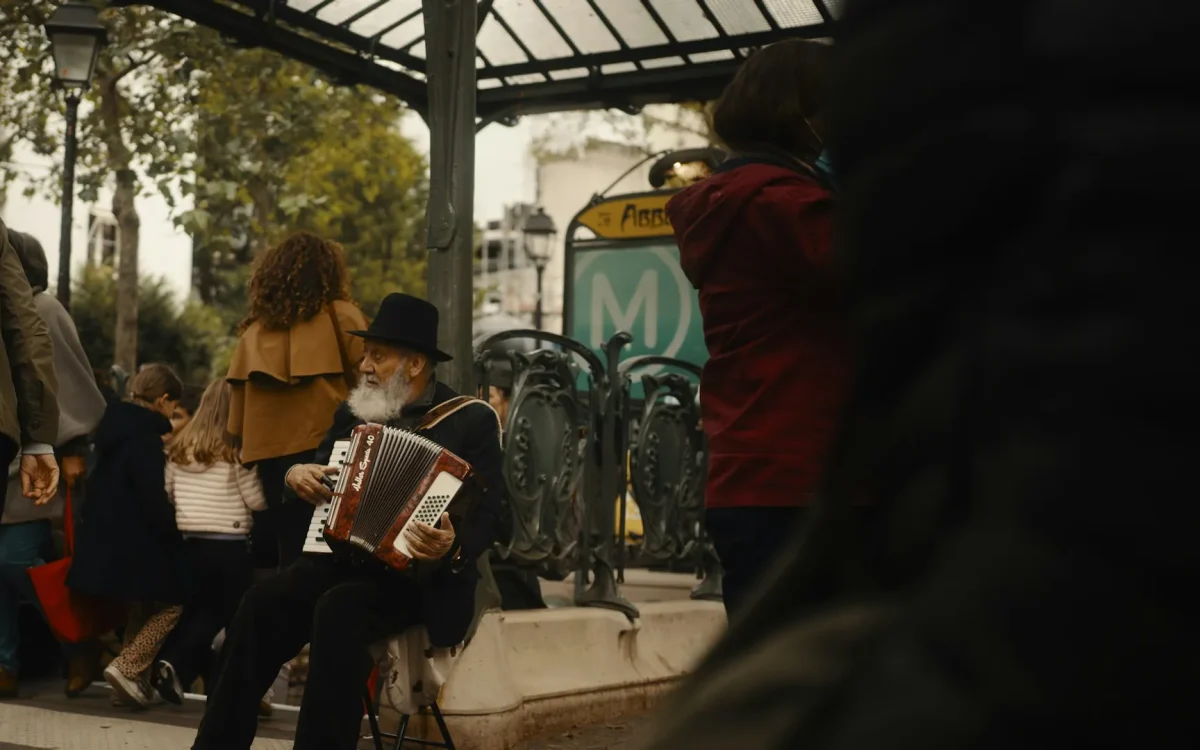
The accordion became a symbol of Parisian popular music through the bal musette, dance halls where waltzes, java and other dances were played by accordionists. The accordion often accompanied chanson réaliste and became part of the romantic image of Paris. It also connects chanson with gypsy jazz, as Django Reinhardt began his career accompanying accordionists. See gypsy jazz.
Yé-yé and pop
In the 1960s, young French singers inspired by British and American rock and pop created the yé-yé style. Françoise Hardy, Sylvie Vartan and Johnny Hallyday became stars, and Serge Gainsbourg wrote songs for many of them. Yé-yé brought a lighter, youthful sound, but chanson à texte continued alongside it.
Chanson today
In the 1990s, French law introduced quotas requiring radio stations to play a minimum share of French-language songs, which supported local artists. New generations continue the chanson tradition, often mixing it with pop, electronic music, hip-hop and world music. Artists such as Zaz, Benjamin Biolay, Christine and the Queens and the Belgian singer Stromae have brought the spirit of chanson to new audiences.
A closer look: listening to the words
If you do not speak French, find translations of the lyrics before listening to a classic chanson. Read the text first, then listen to the song while following the translation. You will notice how the singer shapes each phrase, emphasises particular words and uses pauses to create drama. The meaning of the words is central to the experience.
Putting it into practice
Listen to Piaf’s “La Vie en rose”, Brassens singing one of his own poems, Brel’s “Ne me quitte pas” and a song by Barbara. The Music Travel Phrasebook AI can explain French musical vocabulary, and the Global Playlist Curator AI can build a chanson playlist.
Frequently asked questions
What is chanson à texte?
A French song in which the lyrics are the most important element.
Who was Édith Piaf?
The most famous French singer of chanson réaliste, known for “La Vie en rose”.
Was Jacques Brel French?
No, he was Belgian, though he worked mostly in France and is a central figure of chanson.

Questions and notes