Balkan Brass: The Wild Sound of Serbian and Macedonian Bands
Blazing trumpets, pumping tubas and odd-meter grooves: Balkan brass bands are the life of weddings and festivals from Serbia to Romania. Their military roots, Romani virtuosos, the Guča festival, odd meters and their global breakthrough.
In this guide
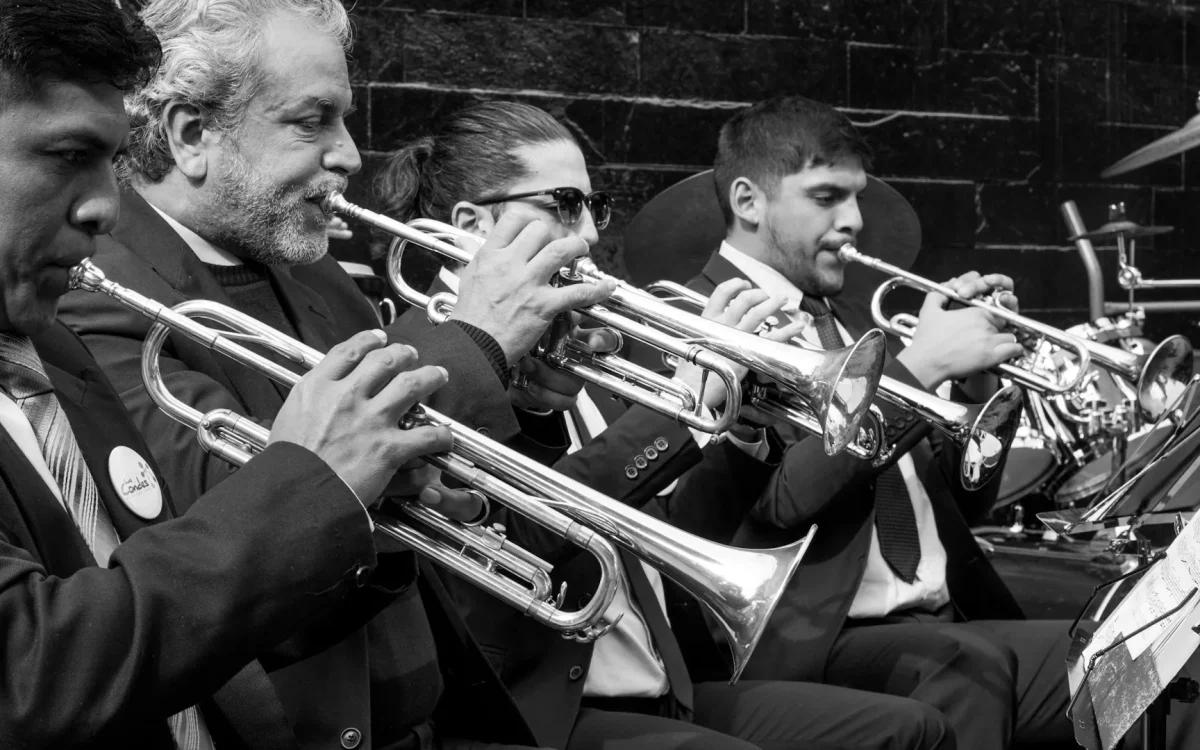
Trumpets and flugelhorns blaze out fast, ornamented melodies, tubas pump out bass lines, a big drum thunders and the whole crowd dances in a circle. Balkan brass bands are one of the most exhilarating sounds in world music, the soundtrack of weddings, baptisms, festivals and celebrations across Serbia, North Macedonia, Romania, Bulgaria and beyond. Many of the greatest bands are led by Romani musicians, whose virtuosity has made Balkan brass famous around the world. This guide explains its history and sound.
Military roots
Brass instruments came to the Balkans through military bands. The Ottoman Empire had its mehter bands with drums and wind instruments, and in the nineteenth century, as Balkan states gained independence, they founded military bands modelled on those of Austria and other European powers. In Serbia, Prince Miloš Obrenović established a military band in the 1830s. After military service, musicians brought brass instruments back to their villages, where they began playing folk melodies and dances. See Turkish music.
The instruments
| Instrument | Role |
|---|---|
| Trumpets and flugelhorns | Lead melodies, ornaments and solos |
| Tenor horns and baritones | Harmony and rhythmic off-beats |
| Tuba, helicon or euphonium | Bass lines |
| Saxophones and clarinets | Melodies, especially in Macedonian bands |
| Tapan (big drum) | Powerful bass drum with a cymbal or stick |
| Snare drum | Rhythmic drive |
The tapan, a large double-headed drum played with a heavy stick on one side and a thin stick on the other, is related to the Turkish davul and gives the bands their earthy pulse.
Romani musicians
Romani communities have long been professional musicians in the Balkans, playing for weddings and celebrations of all communities. Many of the most celebrated brass bands are Romani, known for their improvisational skill, speed and expressive ornamentation. Romani bands have also absorbed influences from Turkish, Greek, Jewish, Latin and jazz music, creating a dynamic, evolving style.
Dances and rhythms
Balkan brass music is dance music. The kolo is a circle dance in which dancers hold hands or belts and move with quick steps. The čoček is a Romani dance, often with sensual hip movements, related to Turkish and Middle Eastern dance. Many Balkan rhythms use odd meters, which can feel surprising to listeners used to Western music in two, three or four beats.
Odd meters
Odd meters, called aksak in Turkish (“limping”), group short and long beats. A 7/8 rhythm may be counted as 3+2+2, a 9/8 as 2+2+2+3 and an 11/16 as 2+2+3+2+2. These rhythms appear in Serbian, Macedonian and Bulgarian music. Dancers and musicians feel them naturally, and the uneven grouping gives the music its distinctive forward motion. Try clapping 7/8 as “one-two-three, one-two, one-two” with a clap on each “one”.
The Guča Trumpet Festival
Since 1961, the small town of Guča in western Serbia has hosted the Dragačevo Trumpet Festival, usually called the Guča festival. Each August, brass bands compete, and visitors from Serbia and abroad fill the town for several days of music, dancing and feasting, with bands playing in the streets and around tables. It has become one of the largest music festivals in the Balkans. See the world’s great music festivals.
Famous bands
The Boban Marković Orkestar, a Romani band from southern Serbia, has won many prizes at Guča and toured internationally; Boban’s son Marko Marković continues the band’s legacy. From Romania, Fanfare Ciocărlia, a band from the village of Zece Prăjini, became known for its astonishing speed and energy. From North Macedonia, the Kočani Orkestar, another Romani band, became famous for its fusion of brass with Turkish and Romani influences.
Film and global fame
Balkan brass reached international audiences in part through the films of the Serbian director Emir Kusturica, such as Time of the Gypsies (1988) and Underground (1995), with music by Goran Bregović, which featured brass bands prominently. Bregović later toured with his Wedding and Funeral Orchestra. In the 2000s, DJs in Germany and elsewhere blended Balkan brass with electronic beats, a style called Balkan beat, popular in clubs across Europe.
Brass beyond the Balkans
Balkan brass has inspired bands around the world, from New York to Berlin, and many brass bands now play Balkan repertoire alongside their own music. Balkan brass also shares features with other traditions, such as klezmer and the brass bands of New Orleans. See klezmer and New Orleans.
A closer look: hearing the ornaments
When you listen to a Balkan trumpet solo, notice the fast ornaments, trills and turns that decorate the melody. Romani trumpeters often play with remarkable speed and agility, almost like a singer. Then listen to the tenor horns playing off-beat chords, which give the music its bouncing feel. The combination of virtuosic melody and pumping rhythm makes it irresistible.
Putting it into practice
Listen to the Boban Marković Orkestar, Fanfare Ciocărlia and the Kočani Orkestar, and compare their styles. Practise odd meters with our metronome. The World Rhythm Coach AI can help you learn 7/8 and 9/8, and the Music Festival Trip Planner AI can help plan a trip to Guča.
Frequently asked questions
Where do Balkan brass bands come from?
From military bands introduced in the nineteenth century, adopted by village and Romani musicians.
What is the Guča festival?
A brass band festival held each August in Guča, Serbia, since 1961.
What are odd meters?
Rhythms with uneven groups of beats, such as 7/8 counted 3+2+2.
Questions and notes