Scottish Folk Music and the Great Highland Bagpipe
Scotland's music ranges from the stirring Great Highland Bagpipe and its classical piobaireachd to fiddle strathspeys, Gaelic song and ballads. How the pipes work, pipe bands, the Scotch snap, Burns, the folk revival and Celtic Connections.
In this guide
Few sounds are as instantly recognisable as the Great Highland Bagpipe: a powerful, continuous drone underneath a soaring melody that can be heard across glens and parade grounds. But Scottish music is much more than bagpipes. It includes a classical piping tradition of great depth, a lively fiddle tradition with its own unique rhythm, haunting Gaelic songs, ballads in Scots and a thriving modern folk scene. This guide explores Scotland’s musical heritage.
The Great Highland Bagpipe
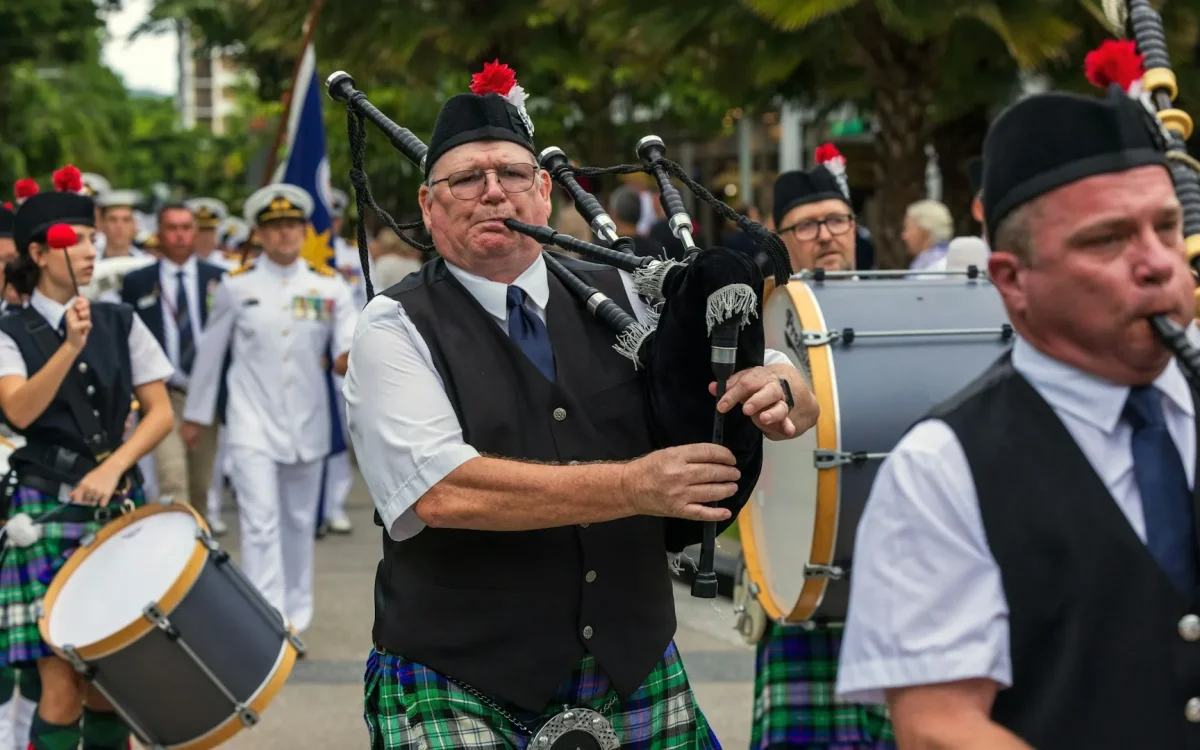
The Great Highland Bagpipe consists of a bag, traditionally made of sheepskin or hide and now often synthetic, which the piper fills with air through a blowpipe. Squeezing the bag under the arm pushes air into three drones, two tenor drones and one bass drone, which sound continuously, and into the chanter, a pipe with finger holes on which the melody is played. The chanter has a range of only nine notes, and because the sound is continuous, pipers cannot separate notes by stopping the air.
| Part | Function |
|---|---|
| Bag | Air reservoir that keeps the sound continuous |
| Blowpipe | Through which the piper fills the bag |
| Chanter | Melody pipe with nine notes |
| Tenor drones (2) | Sound the keynote an octave below the chanter |
| Bass drone | Sounds the keynote two octaves below |
Gracenotes
Because pipers cannot stop the air between notes, they separate and emphasise notes with gracenotes, very quick notes played before a melody note. Combinations of gracenotes, with names such as doublings, throws, grips and birls, give piping its distinctive articulation and rhythmic drive. Mastering these embellishments takes years of practice, usually starting on a practice chanter, a quieter instrument without a bag or drones.
Piobaireachd: the big music
Piobaireachd (pronounced “pee-broch”), also called ceòl mòr or “big music”, is the classical music of the Highland bagpipe. A piobaireachd begins with a slow theme, called the ground or ùrlar, followed by a series of increasingly complex variations, before returning to the theme. A performance can last fifteen minutes or more. Hereditary piping families, most famously the MacCrimmons, pipers to the MacLeods of Dunvegan on Skye, developed and taught this music for generations.
Ceòl beag: the little music
Ceòl beag, or “little music”, includes marches, strathspeys, reels, jigs and hornpipes. These tunes are played at competitions, parades, dances and ceremonies. Pipe marches in 2/4, 6/8 and other times are among the most popular pieces, and competition pipers often play a set called a march, strathspey and reel.
Pipe bands
A pipe band combines a group of pipers with a drum corps of snare drums, tenor drums and a bass drum. Pipe bands developed largely through the military, and today civilian bands compete in grades around the world. The World Pipe Band Championships, held each August in Glasgow, bring together bands from many countries. Highland games, held across Scotland in summer, feature piping competitions alongside athletics and dancing.
Fiddle music and the strathspey
Scotland has a strong fiddle tradition. In the eighteenth century, fiddlers such as Niel Gow composed and played tunes for dancing, and many are still played today. The most distinctive Scottish tune type is the strathspey, a slow, stately dance tune featuring the “Scotch snap”, a short note on the beat followed by a longer one. Regional styles include the North-East style and the Shetland fiddle tradition, made famous by players such as Aly Bain.
Gaelic song
In the Scottish Highlands and Islands, Gaelic song is a deep tradition. Waulking songs were sung by women as they beat and shrank woollen cloth, with a lead singer and a chorus keeping rhythm. Puirt à beul, “mouth music”, are lively songs for dancing, sometimes sung when instruments were not available. Psalm singing in Gaelic, with a precentor leading and the congregation following in a free, ornamented style, is a remarkable sound of the Hebrides.
Ballads and Burns
Scotland has a rich tradition of ballads, long narrative songs about love, murder, battles and the supernatural, many collected in the nineteenth century. The poet Robert Burns (1759–1796) collected, adapted and wrote hundreds of songs, including “Auld Lang Syne”, sung around the world at New Year. His songs remain at the centre of Scottish identity, especially on Burns Night, 25 January.
Revival and modern folk
The Scottish folk revival of the 1950s and 1960s brought singers and bands to wider audiences. The Corries wrote “Flower of Scotland”, which became an unofficial national anthem. Bands such as Runrig and Capercaillie brought Gaelic language and traditional music into rock and pop, and the Battlefield Band and many others developed new arrangements. The Celtic Connections festival, held in Glasgow each January since 1994, is one of the world’s largest folk music festivals.
A closer look: hearing the drone
When you listen to the Highland bagpipe, notice how the drones create a constant harmonic foundation, against which the melody moves, sometimes in harmony and sometimes in tension. Then listen for the gracenotes, which sound like quick flicks before the main notes. These two features, drone and gracenotes, give the pipes their unique character. See bagpipes around the world.
Putting it into practice
Listen to a piobaireachd, a pipe band performance, a Shetland fiddle recording and a Gaelic waulking song. The Music Festival Trip Planner AI can help plan a visit to Celtic Connections or the World Pipe Band Championships, and the Instrument Origins Guide AI can tell you more about the bagpipe’s history.
Frequently asked questions
What is piobaireachd?
The classical music of the Highland bagpipe, a theme with variations.
How many drones does a Highland bagpipe have?
Three: two tenor drones and one bass drone.
What is a strathspey?
A Scottish dance tune featuring the Scotch snap rhythm.
Questions and notes