Japanese Traditional Music: Koto, Shakuhachi and Shamisen
Japanese traditional music values clarity, space and tone colour. The koto, shakuhachi and shamisen, the ancient court music gagaku, the music of noh and kabuki, Japanese scales and the idea of ma.
In this guide
Japanese traditional music often sounds spacious and deliberate. A single note on the shakuhachi flute can swell, fade and change colour; the plucked strings of the koto ring out and decay into silence; the shamisen snaps and buzzes in the theatre. Rather than complex harmony, Japanese music values the quality of each sound, the expressive use of silence and subtle changes of timbre. Many traditions have been passed down for centuries, alongside Japan’s modern popular music. This guide introduces the main instruments and genres.
Gagaku: the music of the court
Gagaku, meaning “elegant music”, is the ancient court music of Japan. It arrived from China and Korea between the fifth and ninth centuries and developed at the imperial court, where it is still performed today by the musicians of the Imperial Household Agency. Gagaku is often described as one of the oldest surviving orchestral traditions in the world. Its sound is slow and majestic, with the shō (a mouth organ of bamboo pipes) playing sustained clusters of notes, the hichiriki (a double-reed pipe) carrying the melody and the ryūteki flute adding ornamentation, accompanied by drums and gongs.
The koto
The koto is a long zither, traditionally with thirteen silk strings stretched over movable bridges on a wooden body about 1.8 metres long. The player plucks the strings with picks worn on the thumb and first two fingers of the right hand, and presses the strings on the other side of the bridges with the left hand to bend pitches and add vibrato. Moving the bridges changes the tuning for different pieces. The blind musician Yatsuhashi Kengyō, in the seventeenth century, is credited with developing koto music for solo performance, and his piece “Rokudan no Shirabe” remains a classic. In the twentieth century, Michio Miyagi composed new works, such as “Haru no Umi” (“The Sea in Spring”), that blended koto with Western influences.
The shakuhachi
The shakuhachi is an end-blown bamboo flute with four finger holes on the front and one on the back. Its name refers to its standard length, one shaku and eight sun, about 54 centimetres. By changing the angle of blowing and partially covering holes, players can bend pitches, produce breathy and airy sounds and create dramatic swells. In the Edo period, the shakuhachi was played by wandering monks of the Fuke sect of Zen Buddhism, called komusō, who wore basket hats covering their heads and played honkyoku, solo pieces used as a form of meditation. Today the shakuhachi is played in traditional ensembles, solo, in film music and in fusion projects.
The shamisen
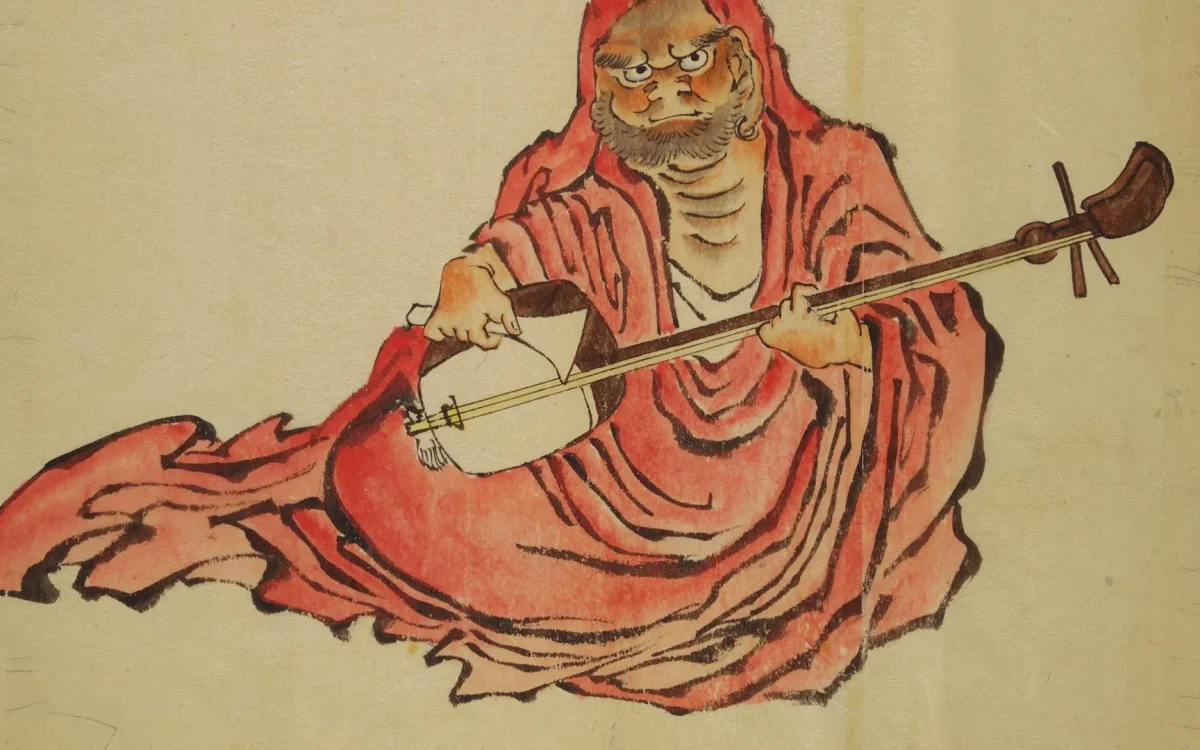
The shamisen is a three-stringed lute with a long neck and a square body traditionally covered with animal skin, today often synthetic. The player strikes the strings with a large plectrum called a bachi, producing a sharp, percussive sound, and the instrument has a characteristic buzz called sawari. The shamisen arrived in Japan in the sixteenth century via Okinawa, where its ancestor, the sanshin, is still played. It became central to the music of kabuki theatre, bunraku puppet theatre and the entertainment districts of Edo. The energetic Tsugaru-jamisen style, from Aomori in northern Japan, features fast, virtuosic improvisation and has become popular with younger audiences.
| Instrument | Type | Known for |
|---|---|---|
| Koto | 13-string zither | Solo and ensemble music, movable bridges |
| Shakuhachi | Bamboo flute | Breathy tone, Zen meditation pieces |
| Shamisen | 3-string lute | Kabuki, bunraku, Tsugaru style |
| Shō | Mouth organ | Sustained chords in gagaku |
| Taiko | Drums | Festivals, theatre, ensemble drumming |
Music for the theatre
Noh, a form of theatre developed in the fourteenth century, uses a small ensemble called hayashi: a flute (nōkan) and three drums, the kotsuzumi, ōtsuzumi and taiko. The drummers also make vocal calls, called kakegoe, that mark time and add intensity. A chorus sings the text in a chanting style. Kabuki, which developed in the seventeenth century, uses a richer ensemble with shamisen, singers and percussion, and its music, such as nagauta (“long song”), accompanies dance and drama. See taiko drumming.
Japanese scales
Much Japanese traditional music uses pentatonic scales. The in scale (also called miyako-bushi) includes semitones and has a melancholy, haunting quality, used in much koto and shamisen music. The yo scale has no semitones and sounds brighter, often used in folk songs. Okinawan music uses its own distinctive scale. You can hear the in scale in our World Scales Explorer.
Ma: the beauty of space
The Japanese concept of ma refers to the space or interval between things. In music, ma is the silence between notes, which is considered as important as the notes themselves. A performer may leave long pauses, letting a sound fade completely before the next one. This sense of space gives Japanese traditional music its contemplative character and encourages close listening.
Folk songs: min’yō
Japan has a rich tradition of folk songs called min’yō, associated with regions, work and festivals. They are sung at summer Bon festivals, where communities dance in circles, and accompanied by shamisen, flute and drums. Each region has its own songs, and many have been popularised through recordings and competitions.
A closer look: listening to one note
Choose a shakuhachi honkyoku recording and listen to just the first few notes. Notice how each note begins, changes and ends: the breath sound, the swell, the bending of pitch and the fade. Then listen to a koto piece and notice how each plucked note decays into silence before the next. This attention to the life of individual sounds is the key to enjoying Japanese traditional music.
Putting it into practice
Listen to a gagaku performance, a koto piece by Yatsuhashi or Miyagi, a shakuhachi honkyoku and a Tsugaru-jamisen performance, and compare them. The Instrument Origins Guide AI can tell you more about each instrument, and the Global Playlist Curator AI can suggest recordings.
Frequently asked questions
What is the oldest Japanese music?
Gagaku, the imperial court music, which developed from music brought from China and Korea over a thousand years ago.
What is a shakuhachi?
An end-blown bamboo flute associated with Zen meditation and the komusō monks.
How many strings does a koto have?
Traditionally thirteen, stretched over movable bridges.

Questions and notes