Andean Music: Panpipes, Charango and Mountain Sounds
The music of the Andes, from Peru and Bolivia to Ecuador, Chile and Argentina, combines Indigenous flutes and panpipes with string instruments brought by the Spanish. Its instruments, the huayno, panpipe playing in pairs and famous songs.
In this guide
The sound of panpipes drifting across mountain valleys is one of the most evocative images of South America. Andean music, from the highlands of Peru, Bolivia, Ecuador, northern Chile and northern Argentina, is a living tradition that blends ancient Indigenous instruments with string instruments introduced after the Spanish conquest. It is played at festivals, in village celebrations, in city concert halls and by street musicians all over the world. This guide introduces the instruments, styles and stories of Andean music.
Indigenous and Spanish roots
Long before the arrival of Europeans, peoples of the Andes, including the Quechua and Aymara, played flutes, panpipes and drums in rituals and agricultural celebrations. Archaeologists have found ancient panpipes and flutes made from cane, bone and clay. After the Spanish conquest in the sixteenth century, string instruments such as the guitar, harp and violin arrived, and Andean musicians adapted them to local styles. The charango, a small stringed instrument, developed in the Andes during the colonial period. The result is a musical culture that mixes Indigenous melodies and scales with European harmony and instruments.
The instruments
| Instrument | Description |
|---|---|
| Quena | Notched end-blown flute, traditionally of cane, with a breathy, expressive tone |
| Siku / zampoña | Panpipes made of cane tubes, often played in pairs |
| Charango | Small ten-string instrument with a bright, sparkling sound |
| Bombo | Large drum with a deep, booming sound |
| Guitar | Harmony and rhythm |
| Rondador | Ecuadorian panpipe played in a single row |
Panpipes played in pairs
One of the most fascinating features of Andean music is the way the siku is often played. The notes of the scale are divided between two halves of the instrument, called ira and arca, held by two different players. To play a melody, the two musicians alternate notes, interlocking their parts so that the tune emerges from their combined playing. This technique, known as hocketing, creates a sense of community and cooperation: neither player can perform the melody alone. Large siku ensembles at festivals can include dozens of players.
The charango
The charango is a small instrument with ten strings in five pairs. Traditionally, some charangos were made with an armadillo shell as the body, though today most are made of wood. Its bright, shimmering tone and fast strumming give Andean music its sparkle. Bolivia and Peru both have strong charango traditions. See small strings of Latin America.
Musical styles
The huayno is the most widespread Andean genre, with a lively rhythm and often melancholic melodies, danced at celebrations across Peru and Bolivia. The sanjuanito is a festive dance from Ecuador. The cueca and carnavalito are found in Bolivia, Chile and Argentina. Many festivals, such as Inti Raymi (the Festival of the Sun) in Cusco and carnival in Oruro, Bolivia, feature music and dance with elaborate costumes.
Nueva canción and the folk revival
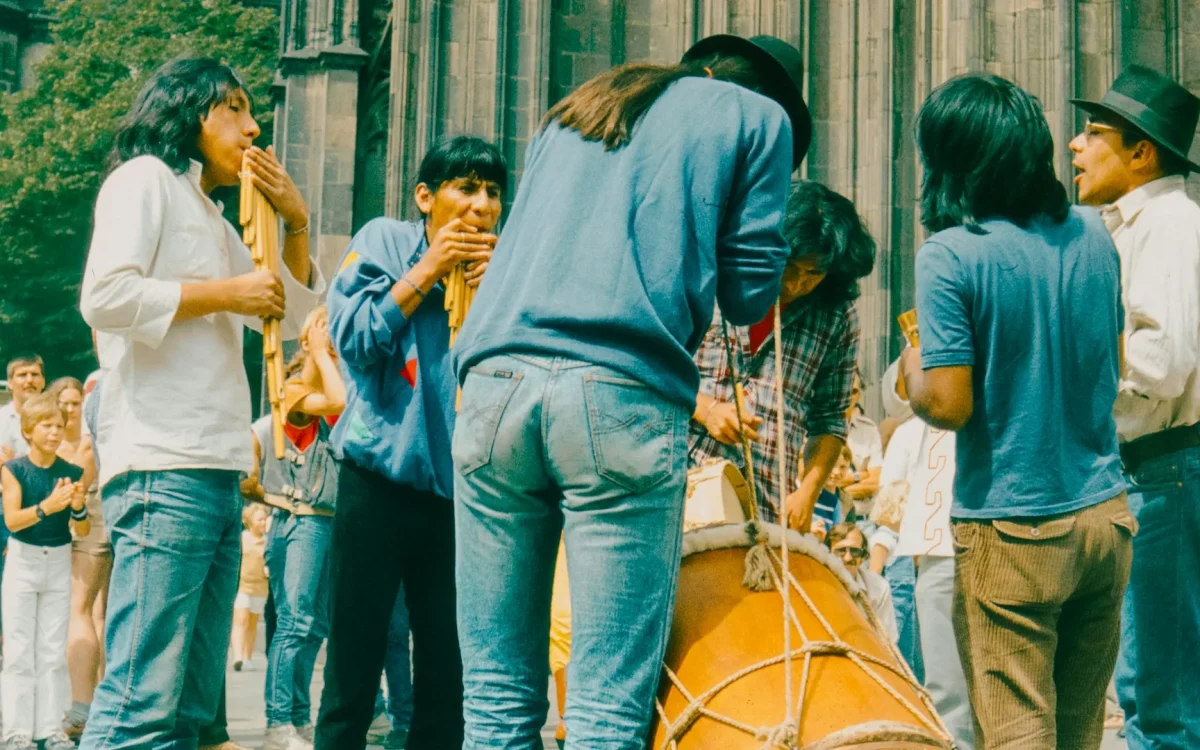
In the 1960s and 1970s, Andean instruments became central to nueva canción, a movement of socially conscious song in Chile, Argentina and other countries. Groups such as Inti-Illimani and Quilapayún from Chile used quenas, sikus and charangos to create a new sound associated with social change. Bolivian groups such as Los Kjarkas later brought Andean music to large international audiences. During this period, Andean bands also became familiar sights in European cities, where street musicians performed to passers-by.
“El Cóndor Pasa”
The most famous Andean melody internationally is probably “El Cóndor Pasa”, composed by the Peruvian composer Daniel Alomía Robles in 1913 for a zarzuela (a musical play), drawing on traditional Andean melodies. The tune became world-famous in 1970 when Simon & Garfunkel recorded a version with English lyrics, based on an instrumental arrangement by the Andean group Los Incas. In 2004, Peru declared the song part of its national cultural heritage.
A closer look: the pentatonic sound
Much traditional Andean music uses pentatonic scales, built from five notes, which give it a distinctive, open and often wistful sound. You can explore pentatonic scales with our free World Scales Explorer, which lets you hear how a five-note scale differs from the familiar major scale. Try playing a pentatonic scale and imagine it on a quena; you will hear the connection to Andean melodies immediately.
Putting it into practice
Listen to a traditional siku ensemble, a huayno with charango and a nueva canción recording, and notice how each uses Andean instruments differently. If you travel to Peru or Bolivia, look out for local festivals. The Instrument Origins Guide AI can tell you more about the quena, siku and charango, and the Global Playlist Curator AI can build an Andean playlist.
Frequently asked questions
What are Andean panpipes called?
They are called siku in Aymara and zampoña in Spanish. In Ecuador, the single-row rondador is common.
What is a charango made of?
Today usually wood. Traditionally, some were made with an armadillo shell as the body.
Who wrote “El Cóndor Pasa”?
The Peruvian composer Daniel Alomía Robles, in 1913, based on traditional Andean melodies.


Questions and notes