Learning the Djembe: A Beginner’s Guide
The djembe is one of the most rewarding drums to learn, with three sounds that open a world of West African rhythm. Its roots, how to choose and hold one, bass, tone and slap, first rhythms, the dunun drums and a simple practice plan.
In this guide
The djembe is one of the most popular hand drums in the world, and for good reason. It is portable, loud enough to fill a room, and capable of an astonishing range of sounds, from deep, booming basses to sharp, cracking slaps. Originating in West Africa, the djembe is now played in drum circles, schools, therapy groups and concert halls around the world. This guide will help you take your first steps, from choosing a drum to playing your first rhythm.
Where the djembe comes from
The djembe comes from the Mandé peoples of West Africa, especially in present-day Mali and Guinea, where it has been played for centuries at weddings, harvest festivals, initiations and celebrations. Traditionally, the djembe is played in ensembles with other djembes and a set of bass drums called dunun, accompanying dancers and singers. In the 1950s, national ballet companies such as Les Ballets Africains of Guinea brought the djembe to international stages, and master drummers such as Mamady Keïta and Famoudou Konaté later taught students around the world.
How a djembe is made
A traditional djembe is carved from a single piece of hardwood in a goblet shape, with a wide bowl at the top and a narrower stem. A goatskin head is stretched over the top and tightened with a system of ropes and rings, which allows the player to raise the pitch by adding twists to the vertical ropes. Modern djembes may also be made from synthetic materials or wood with synthetic heads and mechanical tuning lugs. The goblet shape is essential to the djembe’s sound: the bowl produces bright high tones, while the stem acts as a resonator for the bass.
Choosing a djembe
| Feature | What to look for |
|---|---|
| Head size | About 30 to 35 cm (12 to 14 inches) for adults |
| Shell | Solid carved hardwood for the best sound |
| Head | Goatskin for traditional tone; synthetic for durability |
| Tuning | Rope tuning for authenticity; lugs for easy adjustment |
| Bearing edge | Smooth, rounded edge that is comfortable on the hands |
Avoid very cheap souvenir drums with thin shells and loose heads, which are hard to play well. See our guide to the best djembes for recommendations.
Posture
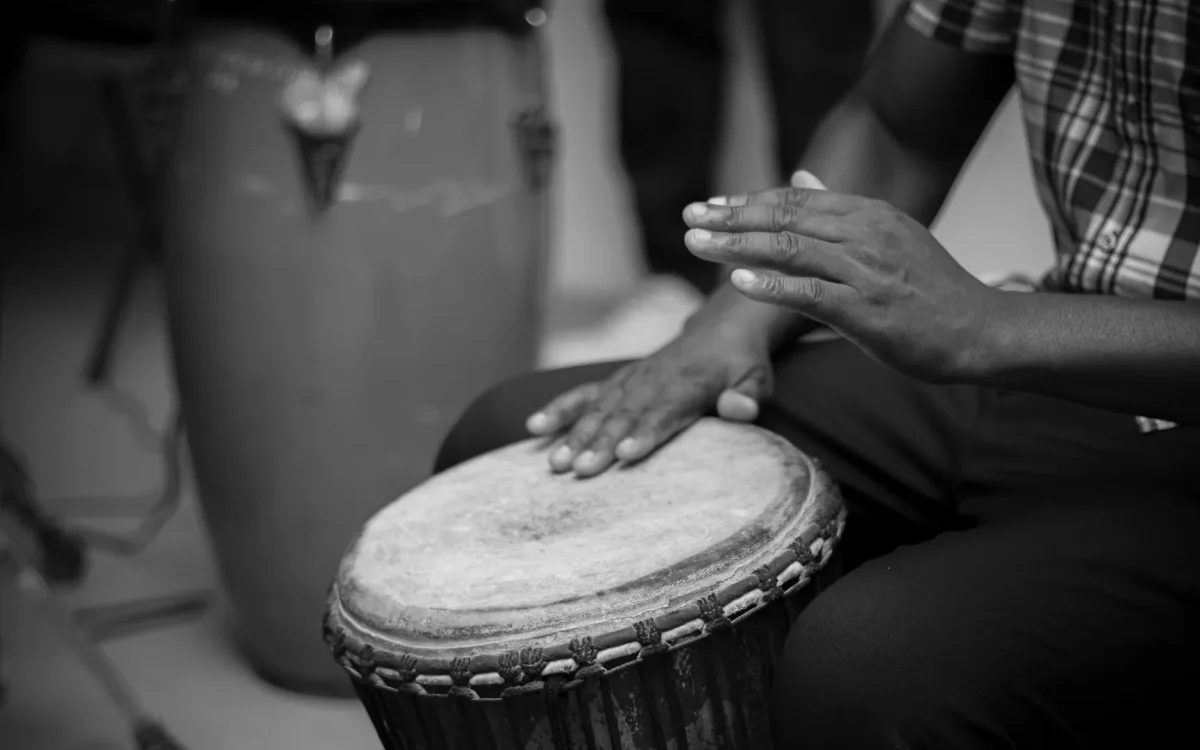
Sit on a chair or stool of a height that lets your thighs slope slightly downward. Place the djembe between your knees and tilt it slightly away from you, so that the bottom of the drum is open and the bass can resonate. Hold the drum gently with your legs. Your arms should be relaxed, with your elbows slightly away from your body and your hands able to strike the head from a comfortable height. Playing standing up with a strap is also common in performances.
The three basic sounds
The djembe has three main sounds. The bass is a deep, low sound produced by striking the centre of the head with a flat, relaxed hand and letting it bounce off. The tone is a clear, ringing sound produced by striking near the edge with the fingers held together, the palm resting near the rim. The slap is a sharp, high crack produced by striking near the edge with relaxed, slightly spread fingers that whip onto the skin. Learning to make these three sounds clearly is the foundation of djembe playing.
First exercises
Start by alternating hands on the bass: right, left, right, left, slowly and evenly. Then do the same with tones, and then with slaps, focusing on making each sound clean and consistent. Next, try patterns such as two basses, two tones, two slaps, repeating them evenly. Use a metronome at a slow tempo, and increase the speed only when the sounds remain clear. Keep your hands relaxed: tension makes the sound worse and can cause pain.
Your first rhythm: Kuku
Kuku is a popular rhythm from Guinea, often taught to beginners. A simple accompaniment part for djembe can be played in a cycle of eight pulses: slap, slap, tone, tone, slap, rest, tone, tone. Repeat it slowly until it flows, then play along with recordings of Kuku. Other beginner rhythms include Djole, Soli and Kassa. Remember that each traditional rhythm has several interlocking parts, and learning them with a teacher or group is the best way to understand how they fit together.
The dunun
In traditional ensembles, the djembe plays with three cylindrical drums called dunun, played with sticks: the small kenkeni, the medium sangban and the large dununba. Each dunun often has a bell attached, played with a metal rod. The dunun provide the melodic and rhythmic foundation of the music, and the djembes play interlocking accompaniment parts, with a lead djembe soloing and signalling to dancers. See African polyrhythm explained.
Playing in a group
The djembe is above all a group instrument. Joining a class or drum circle is the best way to learn, as you will hear how parts interlock and develop your timing. Listen to the other drummers, keep your part steady and avoid playing too loudly. In traditional settings, the lead drummer guides the group, and respecting their signals is part of the music.
Caring for your drum
Keep your djembe away from extreme heat, cold and humidity, which can damage the skin and wood. Do not leave it in a hot car or in direct sunlight. Rope-tuned drums may need retuning over time as the ropes stretch. Store the drum in a padded bag when travelling.
A closer look: protecting your hands
Beginners often play too hard and hurt their hands. The secret of a good djembe sound is not force but technique: let your hands bounce off the head, keep your wrists loose and use the weight of your arm. If your hands feel sore, take a break. Over time, your hands will become stronger, and you will be able to play for longer without discomfort.
Putting it into practice
Practise the three sounds for ten minutes a day for two weeks, then learn the Kuku accompaniment. Find a local class or drum circle. The Learn a World Instrument Coach AI can build a personal practice plan, and the World Rhythm Coach AI can teach you more rhythms step by step.
Frequently asked questions
What are the three basic djembe sounds?
Bass in the centre, tone near the edge with fingers together and slap near the edge with relaxed fingers.
What size djembe should a beginner buy?
For adults, a head of about 30 to 35 cm (12 to 14 inches) is a good choice.
Where does the djembe come from?
From the Mandé peoples of West Africa, especially Mali and Guinea.
Questions and notes